Sponsored Links










International Section
- UEFA Euro History
- UEFA Nations League
- FIFA World Cup History
- FIFA Women's World Cup
- 2012 Olympics
- Home Internationals
Cup History Section
UK Season Galleries
-
Premier & Football League
- 2022-2023
- 2021-2022
- 2020-2021
- 2019-2020
- 2018-2019
-
Scottish Professional Football League
- 2022-2023
- 2021-2022
- 2020-2021
- 2019-2020
- 2018-2019
- Previous Seasons>>>
- NIFL Premiership
- FA Women's Super League
Cymru Premier
Other Leagues
Articles
- The History of Football Kits UPDATED
- Eminent Victorians
- Room 101 - The Worst Kits of All Time
- Influential & Classic Kits
- Strange Hues - Colourful Favourites
- Iconic Away Kits
- Historical Football Kits in Print
External Links




















The Definitive English and Scottish Football Kit Archive
The material on this site is copyright © Historical Football Kits, all rights reserved. Club crests and sponsors' logos are the intellectual property of their respective owners. For more details visit Copyright Information.
Please note that due to advancing age (I am approaching 70 but unfortunately from the wrong direction) and health issues I am no longer adding new season's kits to the site. Historical updates will continue from time to time.
Latest News & Updates
9 July
Here is a random selection from my in-tray.
The Hallam 1860 graphic now has the correct shade of royal blue jerseys.
 This photograph, submitted by Selwyn Rowley, shows Bradford (Park Avenue) playing at Stoke City at the start of the 1930-31 season. At first glance Bradford appear to be wearing a black strip with a single light band on the upper chest. On closer examination and comparison with better quality reference images, I have come to the conclusion that the Bantams are wearing their regular red, amber and black shirts but the different colours are obscured by the poor quality of the image. Furthermore the hoops are very wide and the lower amber band is tucked away in the players' knickers. If you grew up in the north of England as I did, you will know that your mam wouldn't let you out of the house unless your shirt was neatly tucked in.
The socks worn by Arsenal against Barnsley in the FA Cup in February 1936 have been corrected.
My thanks to Mick Comben, chair of the Portsmouth History Society, who has written concerning the link between Field Marshal Montgomery and the adoption of red socks by Portsmouth in December 1947. Read more on the Portsmouth club page.
Photo Credit: The Evening Sentinel September 2 1930.
8 July
Our Grimsby Town Elf, Dave Wherry, has uncovered some fascinating material that sheds light on the club's earliest colours. Firstly it now seems the photograph ascribed to the original Grimsby Pelham is in fact of Grimsby Town and dates from 1882-83. We now have contemporary written evidence from one of the founders of the club that Pelham's original jerseys and socks had broad hoops and were accompanied by a remarkable cap or cowl.
 Dave also found several contemporary head and shoulder images of players wearing striped shirts between 1897 and 1899. We have generally thought that the Mariners wore plain white shirts during this period but further research on the Mariners' Archive website reveals more examples. Football League regulations of the time required teams to have a set of white tops to wear should colours clash so we can assume the stripes were their first choice. The question of colours is more tricky but having pored over as many examples as I could find I have opted for chocolate and light blue. Assuming the portraits were taken using orthographic film, the blue woud be very pale, almost white while the brown would come out dark grey. Of course, given the vagaries of Moor's Law I am almost certainly wrong.
Dave also stumbled upon a match report documenting Gainsborough Trinity's stunning 1883-84 strip.
7 July
Our good friend, Tony Sealey, has been busy burrowing into the British Newspaper Archive. Here he found a letter sent to the Tottenham Weekly Herald in 1934 from one HEE Bull whose mother was the proud possessor of the Tottenham Hotspur badge worn in cup games between 1886 and 1888. It turns out that this was a Cambridge blue cockspur embroidered onto a piece of white flannel. Presumably this would be attached to players' shirts with a few stitches so it could be removed for the next (non-cup) match. Tony has also found two variations of the striped shirts worn as a change kit between 1909 and 1912.
20 May
Some time ago I received an email from Martin Nisbet, following up on our previous correspondence about Bolton Wanderers switching to black knickers and red/black socks in January 1950. Having contacted the club's official historian, Simon Marland, Martin uncovered a remarkable back story.
 On 1st March 1939 Nazi troops marched into the remainder of Czechoslovakia in breach of the Munich Agreement. Before Bolton's next home game, the club captain, Henry "Harry" Goslin appealed to the crowd to join the Territorial Army. After the game 32 out of 37 Bolton playing staff joined up, 17 of whom joined their local TA unit, the Bolton Artillery, whose football team, consisting of Wanderers players, is shown here. When war broke out they served in the North Africa and Italian campaigns where Goslin lost his life. The link forged between the football club and TA was a strong one so when it was decided to change the team's traditional colours it seems the new socks were supplied by the 53rd Field Artillery.
Photo credit & full story: The Observation Post
 And there's more! If like me you thought that Bolton Wanderers wore their traditional colours in the 1953 FA Cup final you would be WRONG! According to Simon Marland, the team reverted to white and black for the occasion. We know that the management wanted the Bolton team to turn out in kit made from the novel, shiny fabric that was becoming available and I speculate that they could not source navy knickers in this material so opted to revert to black instead.
 The 1980s were a lean time for Hartlepool United as the club sought to cut costs in the face of mounting financial problems. This might explain why the team shirts did not feature a crest between 1978 and 1985. Nevertheless a new official badge did appear on the cover of their match programmes in 1980-81, as shown on this example found by Mark Alton. Variations of this adorned Pools' programmes until 1985 when a smart new club crest was introduced (and added to their shirts).
 This shirt belonged to Robert Clark, a member of the the Newcastle United team that won the League Championship in 1926-27 and was recently sold at auction for £6000. It is one of several that have survived, some of which are on display in museums. Although there is no doubt that these are authentic, the puzzling thing is that there is no evidence that they were ever worn in a match nor does it appear in any match photographs for the following season, 1927-28. In the opinion of the club's historian, Paul Joannou, the badges were presented to the members of the title winning team, some of whom had them stitched on to their shirts as a souvenir. (Replicas of this historic shirt can be bought from UKSoccershop via HFK's Newcastle United page and will cost you considerably less than six grand).
Photo credit: Graham Budd Auctions
19 May
Scottish 1997-98 updates contd: Albion Rovers (depth of yoke increased), Motherwell (numbers added to shirt), Aberdeen (collar and trim amended), Dundee United (sleeves & socks adjusted), Rangers (detailing on 2nd & 3rd kits tweaked).
 Quite often squad photographs of the bigger Scottish teams had the players decked out in both the first and second kits of the time, a helpful feature for we obsessives. This picture of the Rangers 1936-37 squad is a good example and reveals that the team had reverted to white shirts as their alternative. Notably these had featured the club's monogram crest as far back as 1915, more than 50 years before this appeared on their first choice shirts.
St Mirren (1964-65 stripes on warm weather kit adjusted, hoops on socks of 1964-66 cold weather kit adjusted).
16 May
 Along with the material uploaded a few days ago, Ian McConnel included this fascinating photograph of Rangers taken in 1885-86. The most striking feature is that some players are wearing dark (ie navy) knickers while others sport the more familiar white. Such variations were not unusual at the time when players provided their own kit but this is the first photographic evidence we have that the 'Gers team were no exception.
 While trying to corroborate the 1885-86 image I stumbled across this cutting which confirms Rangers' change strip from 1909-10.
Photo Credit: Port Glasgow Rangers Supporters' Club.
Now here are some more Scottish club updates from Ian for the 1997-98 season.
Heart of Midlothian (collar and stockings updated), Berwick Rangers (shorts & sock trim corrected), Rangers (collar & cuffs altered), Livingston (trim revised), Raith Rovers (trim on shirt & shorts revised), Dunfermline Athletic (detailing tweaked), St Johnstone (long and short sleeved versions now displayed), Kilmarnock (detailing improved), Clydebank (shorts trim added). More to follow.
13 May
After a lengthy sabbatical to recharge my batteries we're back and kicking off with some very long overdue Scottsh club updates for 1996-97 from Ian McConnel.
Aberdeen (detailing added), Hibernian (raglan sleeves removed, collar redrawn, crest amended), East Fife (shorts trim corrected), Dundee United (sleeves & socks adjusted), Dunfermline Athletic (thigh trim made more prominent), Rangers (detailing added to 1st & 2nd kits), Raith Rovers (cuffs corrected), Kilmarnock (collar detail added, trim on shorts adjusted), Cowdenbeath (shorts altered), Forfar Athletic (graphic added), Ayr United (detailing added).
19 February
I've unexpectedly received some 2023-24 graphics and added these to the site: Brighton & Hove Albion, Burnley, Chelsea, Crystal Palace, Everton, Luton Town, Manchester City, Manchester United, Sheffield United, West Ham United, Chesterfield.
17 February
 With the assistance of Paul Joannou I have begun the further update of the Newcastle United section. So far this has involved some alterations to the text and an overhaul of the West End colours 1882-1892.
The photograph shows the West End team from 1887-88 with the Northumberland Senor Cup.
Photo credit: Newcastle United FC
14 January
 Using Newcastle United: The Ultimate Record 1881-2011 (Joannou, Candlish & Swann 2011) as my point of reference, I have completed a review of Newcastle United's kits from 1881 to 1973. This includes several new graphics for the club's early years as East End but for the most part, the review has captured a lot missing fine details, such as collar trim, variations in the width of stripes and adjustments to dates. We have not been able to confirm that the team photograph published on 2 January is of East End but I have included a graphic in the Change Kit section on a provisional basis because there is some indirect evidence that suggests it might be East End.
The club historian, Paul Joannou has assisted me with the review and has offered to look over the results and I anticipate that some further changes will be made as a result.
The photograph shows the team from 1894-95 when the iconic black and white striped shirts were worn for the first time.
Photo credit: Chronicle Live
6 January
While I was sorting out the Northern Ireland 1947 one-off strip I came across a number of other changes that needed to be made to the Home Nations sections - these are listed below.
England: First choice socks from 1946 to 1957 were black with white turnovers.
Northern Ireland: One-off kit from Novermber 1947 added, socks from 1953-1957 corrected and dates adjusted.
Scotland: 1883-1889 crest now confirmed and corrected.
3 January
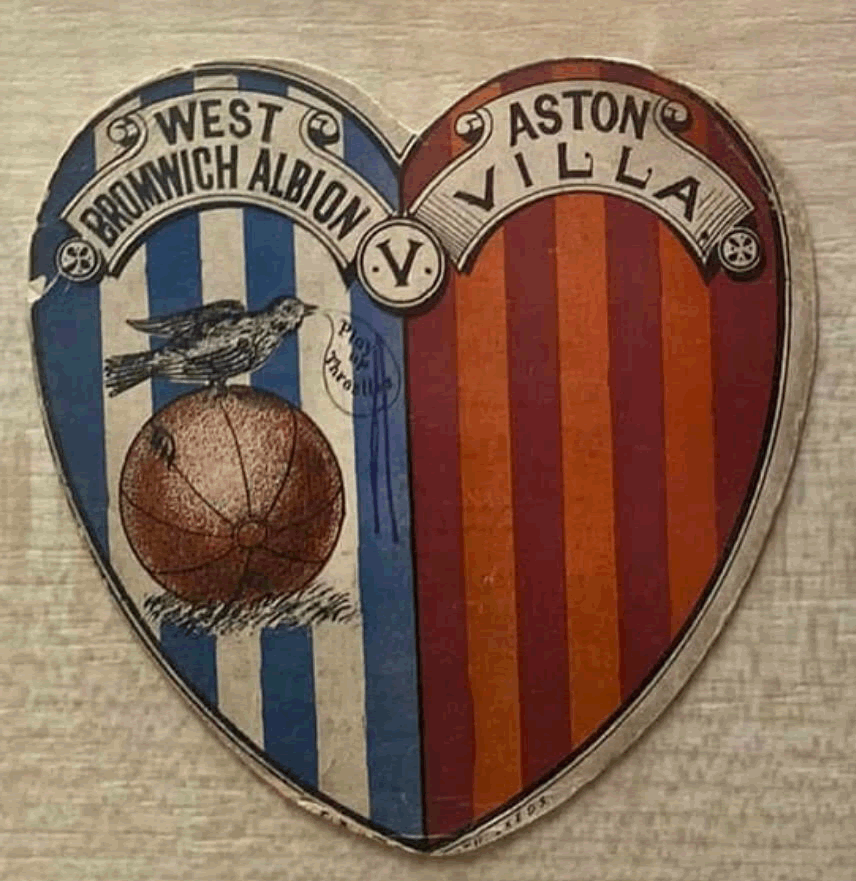 Unravelling the complex and colourful early history of Aston Villa's kits has been one of the more satisfying HFK projects down the years but it seems there are still some twists in the story. Ten years ago I received a press cutting describing Villa's colours in 1885-86 as "coral and maroon." An expert suggested that "coral" was probably a pale shade of blue and so I put together a provisional graphic for the site. A week ago Phil Martin sent me this fascinating item, a "Baines type"colour card issued by Briggs of Leeds to celebrate the midlands derby between West Bromwich Albion and Villa. While it is undated it can only be from 1885-86 as the evidence for the colours of both teams worn in the preceding and following seasons is rock solid. Furthermore, Albion wore their navy and white striped shirts for the first time in 1885-86. While I might be stretching a point I have taken as a clue for the new graphic the fact that the artist has rendered both teams' colours with vertical stripes.
On the subject of unusual colour combinations, Mark Bettany has found new details about Maccesfield Town's 1923-25 kit.
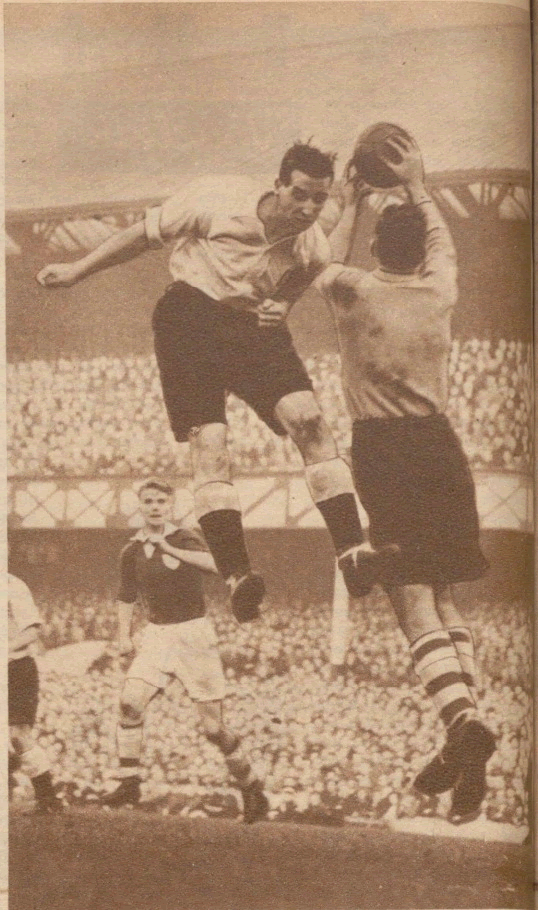 We now turn to this rather puzzling photograph sent to me by Dick Waite last November and published on Facebook. According to the original caption it shows Tommy Lawton in the game against "Ireland" at Goodison Park in 1947. My first response and that of several viewers was that because the Irish team are wearing hooped socks, it must be the Republic of Ireland side, who played at Goodison in 1949. The problem with this interpretation is that Lawton had retired from international football in 1948. Furthermore he is wearing the old FA crest on his shirt which was dropped in 1948.
I then turned to HFK's Northern Ireland Elf, Jonny from NIFG who was as surprised as I was with the picture but by searching through his photographic archive was able to confirm that this was a one-off. The only explanation I have been able to come up with is that once England had adopted black socks with white tops in 1946 the FA sought to avoid clashes with opponents socks and asked Northern Ireland to play in hoops rather than their usual navy and green set. If you think this attitude is both patronising and arrogant you have some measure of what the FA was like in the post-war period.
2 January
Happy New Year!!
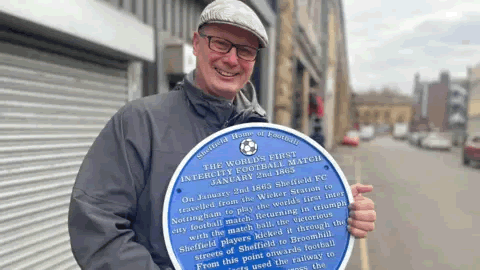 Today marks a rather important anniversary in the history of association football whch has been commemorated with a blue plaque placed on the site of the old Sheffield Wicker Station by members of the Sheffield Home of Football charity, which is seeking Unesco World Heritage status for the city to mark its importance in the early development of the game. It was from here, exactly 160 years ago, that the Sheffield FC team boarded a Midland Raiway train and travelled to Nottingham to play Nottinghamshire FC (later Notts County) in the first ever inter-city match. The visitors won 1-0 and were presented with the match ball which they then kicked through the streets of Sheffield to their home in Broomhill. The rapid growth of the railway network would play a crucial role in the development of football in the coming decades.
Photo credit: BBC
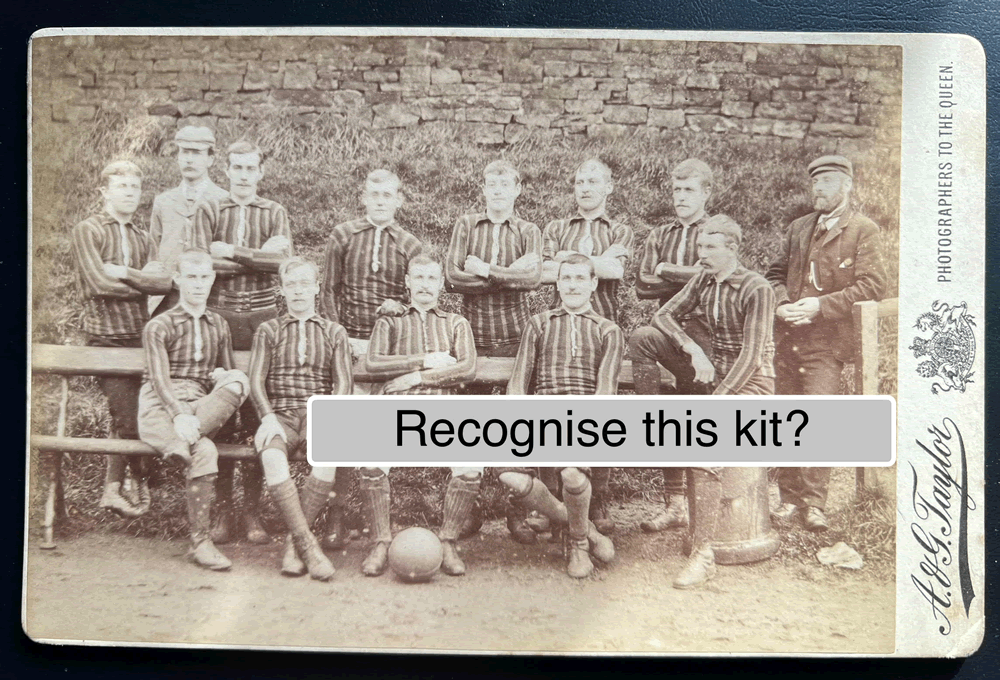 I was recently sent this photograph by a researcher who is working on a website project concerning East End FC, the forerunner of Newcastle United. The reseacher, who wishes to remain anonymous, bought the photograph from a collector in the belief that it showed the East End team from sometime in the late 1880s. He believes he has identified the player perched on what apears to be a chimney pot on the right as Joe McKane who joined East End from Clydebank in 1888 but he has not been able to confirm this. Vertical stripes were still a novelty at this time but the closely fitted shirt with collar and cuffs cut from the same fabric as the main body are remarkably similar to those worn by Aston Villa around this time which seems to support a late 1880s date. The photographer, A&G Taylor (Photographer to the Queen) were based in Carlisle but had four studios in the north-east including one in Newcastle so it's quite possible East End would have patronised the company.
The catch is that I cannot find any source material that confirms East End playing in stripes apart from a fleeting reference in Pioneers of the North (P Joannou & A Candlish 2009) that mentions the team occasionally wore chocolate and blue stripes but provides no dates. If we allow that the players are wearing chocolate, dark and light blue stripes then perhaps this is indeed East End in stripes.
Please get in touch if you can shed any light.