

Kit History
Newton Heath LYR
1878
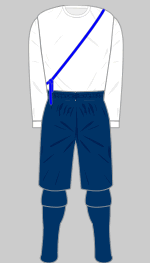
1878-1880 o
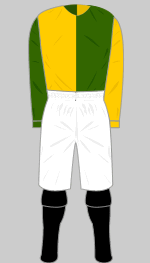
1881-1886 o
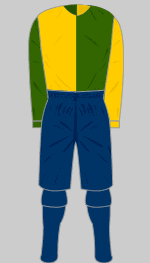
1886-1887 a o

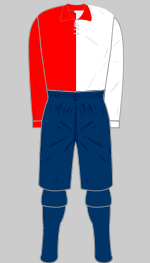
1887-1890 o z
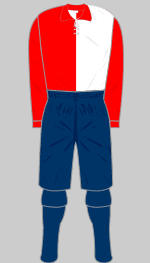
1890-1891 o
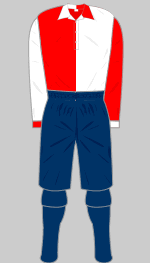
1891-1892 o
Newton Heath
1892
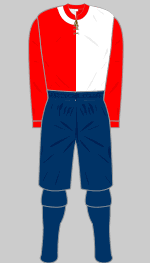
1892-1893 (1) f o y B
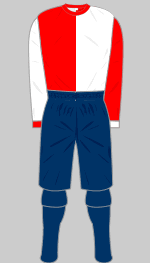
1892-1893 (2) y B
1893-1894 o x v
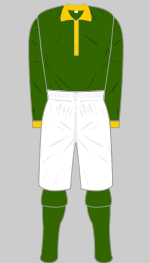
1894-1896 (1) f v w
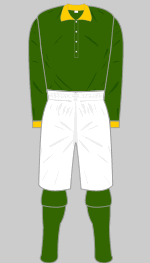
1894-1896 (2) y B
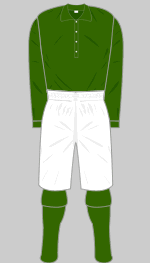
1894-1896 (3) y B
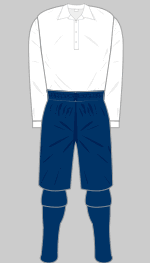
1896-1902 a f v
Manchester United
1902
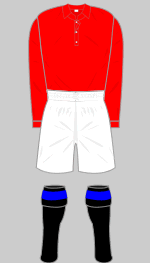
1902-1903 (1) w y
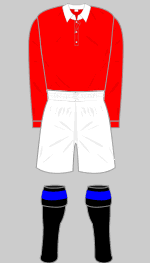
1902-1903 (2) v B
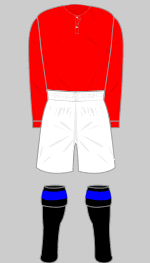
1903-1907 a o v
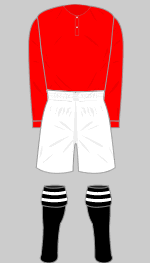
1907-1911 b c v
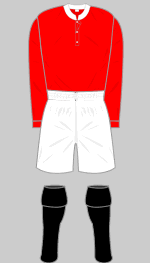
1911-1912 v
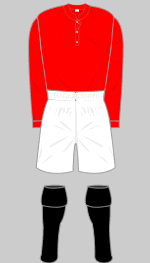
1912-Autumn 13 v y
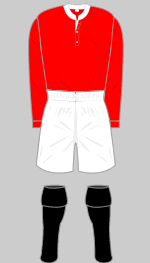
Autumn 13-1914 v y
1914-1919 c v
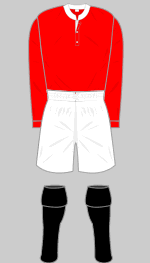
1919-1920 o v
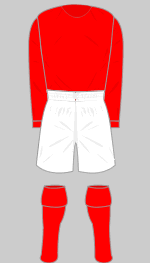
1920-1921 o v
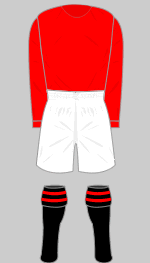
1921-1922 o v y B
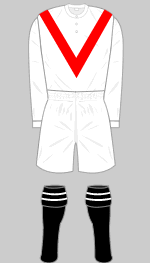
1922-1923 m o q v y B

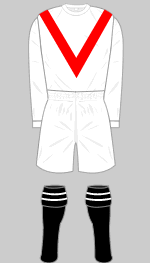
1923-1924 y B
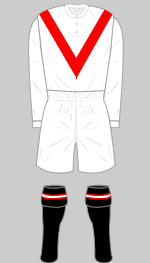
1924-1926 v
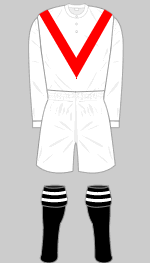
1926-1927 v
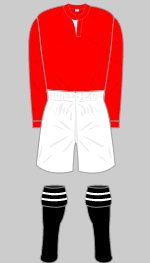
1927-1930 o y
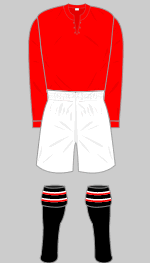
1930-1931 v y
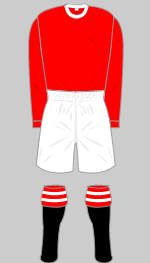
1931-1932 o
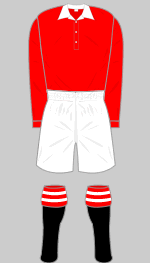
1932-Feb 1934 o y
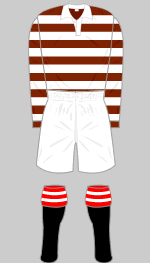
March-May '34 a i j o r
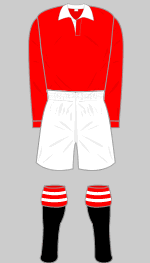
1934-1939 b o u y
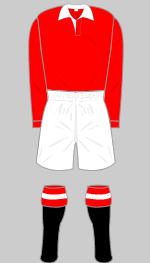
1939-1945 o
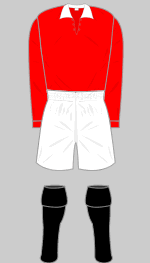
1945-1946 y
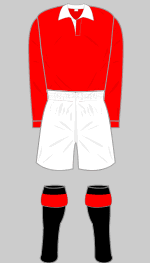
1946-Feb 1949 s y
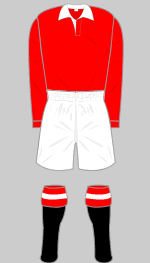
March 49-Aug 55 b o y
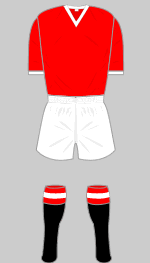
Sept 1955-Oct 60 b y
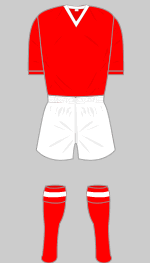
1956-1957 EUR y
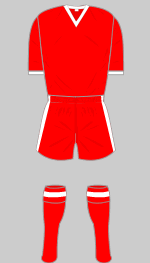
1956-1957 EUR 2 b y
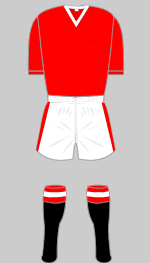
1957-1958 EUR y
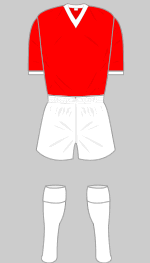
Oct 1960-1961 c u y
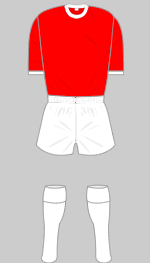
1961-Apr 63 d g h A
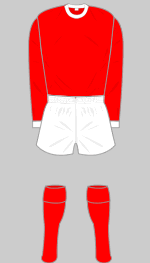
Spring 63-1967 c g h A
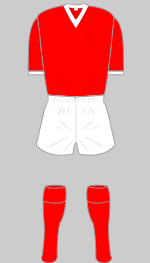
Aug-Sept 1967 o s

Sept 1967-1971 c g h
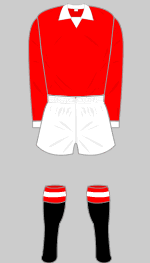
1971-1972 c
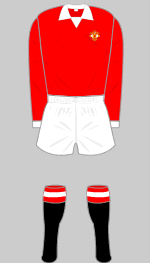
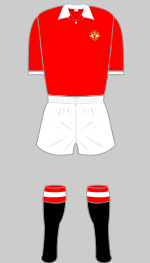
Nov 13 1974-1975 e o
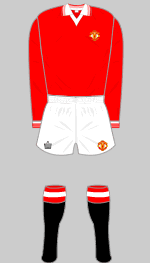
1975-Jan 1976* v
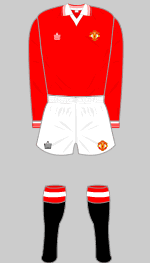
Jan 1976*-1978 c v
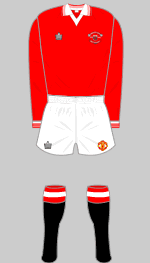
1978-1979 v
1979-1980 c
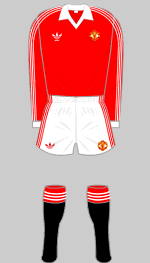
1980-1982 c
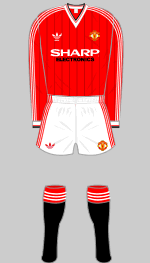
1982-1983 c
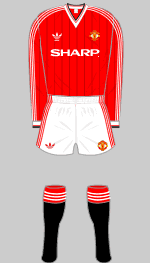
1983-1984 h
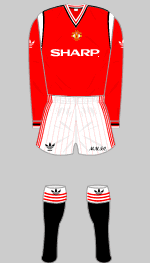
1984-1986 c n

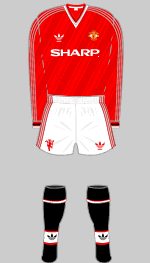
1986-1988 c
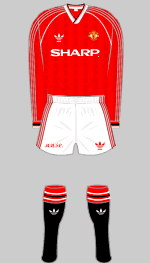
1988-1990 c
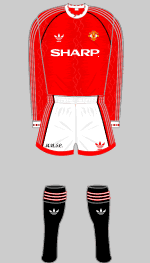
1990-1992 c
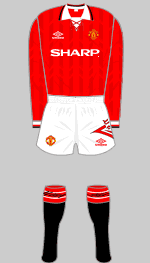
1992-1994 c
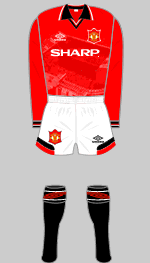
1994-1996 c
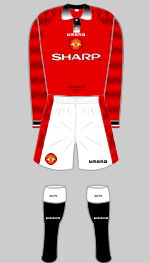
1996-1998 c l
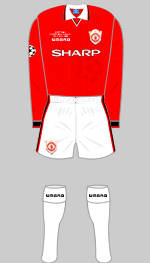
1997-2000 EUR
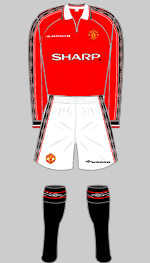
1998-2000 c
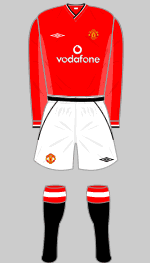
2000-2002 c k
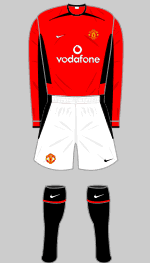
2002-2004 b
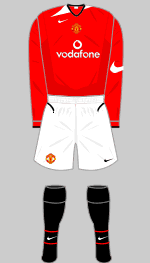
2004-2006 b k
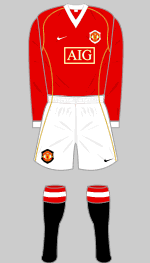
2006-2007 b
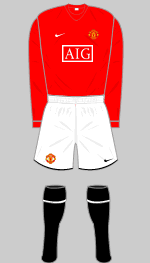
2007-2009 b
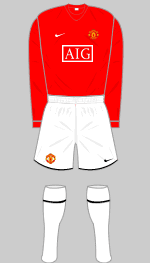
2007-2009 EUR
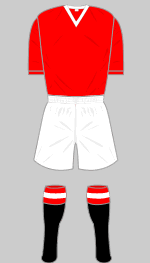
10 Feb 2008 b
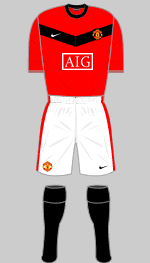
2009-2010 b
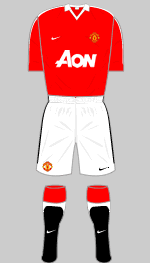
2010-2011 b
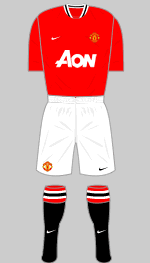
2011-2012 b
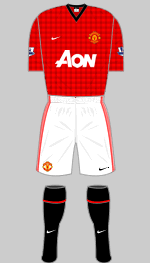
2012-2013 b
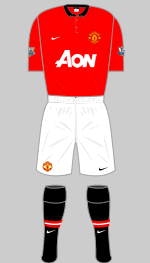
2013-2014 b
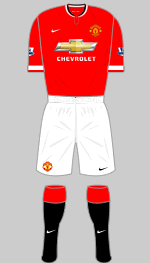
2014-2015 b
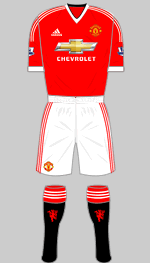
2015-2016 b
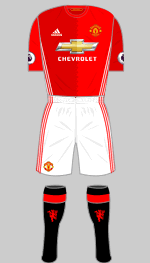
2016-2017 b
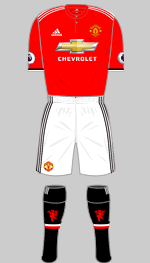
2017-2018 b
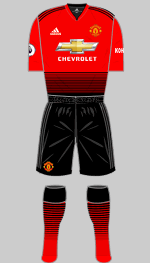
2018-2019 b
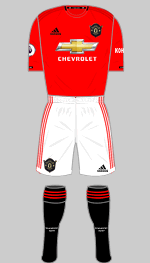
2019-2020 b
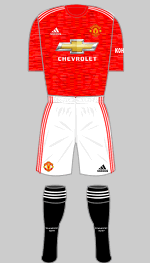
2020-2021 b
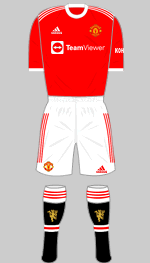
2021-2022 b
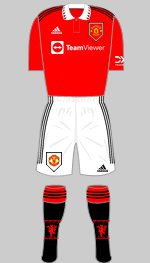
2022-2023 b

2023-2024 b +
Background
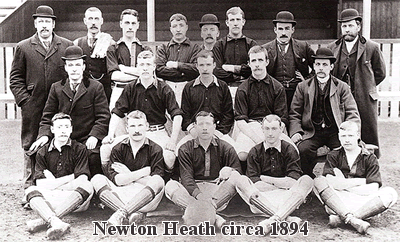 Today Manchester United may
be a global brand and one of the most successful clubs on the planet,
but in the late nineteenth century they were a very unremarkable club
indeed. Formed by railway workers, they were originally known as Newton
Heath LYR (the suffix stood for Lancashire & Yorkshire Railway). Recent (2016) research into the Sportsman's Year Book 1880 by Paul Nagel reveals that their first "colours" were "white with blue cord." It seems likely that as a humble works team, white tops were chosen because they were cheap and widely available and these were embellished with a coloured cord to distinguish them from opponents in similar shirts. It is a matter of speculation whether this was worn across the body (as shown) or round the waist.
Today Manchester United may
be a global brand and one of the most successful clubs on the planet,
but in the late nineteenth century they were a very unremarkable club
indeed. Formed by railway workers, they were originally known as Newton
Heath LYR (the suffix stood for Lancashire & Yorkshire Railway). Recent (2016) research into the Sportsman's Year Book 1880 by Paul Nagel reveals that their first "colours" were "white with blue cord." It seems likely that as a humble works team, white tops were chosen because they were cheap and widely available and these were embellished with a coloured cord to distinguish them from opponents in similar shirts. It is a matter of speculation whether this was worn across the body (as shown) or round the waist.
It is believed that after a whip-round among the players and a contribution from the Dining Room Committee, the club purchased a set of cashmere jerseys in green and gold, the colours of the parent company, in 1881. The club's reputation grew and in 1889, the Heathens had joined the Football Alliance, formed as rivals to the Football League. Research by Paul Nagel indicates that the club switched from green and gold to red and white shirts sometime around 1888 or 1889 (the old jerseys were retained as change colours) while Brian Landamore has found a reference in the Manchester and District rule book from the 1887-88 season that gives their colours as red and white.
In April 1892, the Lancashire & Yorkshire Railway Co repossessed the ground they rented to the club with a view to developing it to benefit all their employees. Although Newton Heath were allowed to continue to use North Road for the following season (at a considerably increased rent), they dropped the "LYR" suffix to emphasise their separate identity.
In 1892 the Alliance was absorbed into the Football League which was restructured into two divisions. Newton Heath successfully applied for one of the vacancies in the new First Division. The competition proved too tough and, having reverted to green and gold shirts, the Heathens were relegated in 1894. The following season the team wore plain green shirts with various collar trims.
By the turn of the century, the club was headed
for bankruptcy. Legend has it that a St Bernard dog belonging to the club
captain wandered off from a fundraising event and was rescued by local
brewer, John Henry Davies. Learning of the club's plight, Davies returned
the dog and invested in the club in return for a place on the board. Davies
brought ambition to the club and in 1902, Newton Heath became Manchester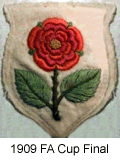 United, adopting red cashmere shirts, white knickers and black socks with blue tops. The collars were orginally red but these were soon replaced by contrasting white ones.
The Edwardian period brought success with a side that included Billy Meredith, signed from rivals Manchester City who were forced to auction off their players after a bribery scandal. Promoted in 1906, United were League Champions in 1908 and 1911 as well as FA Cup winners in 1909. For this match special white shirts with a red chevron were commissioned and a red Lancashire rose embroidered over the heart.
The club moved into their new Old Trafford home in 1909, built on land purchased for the club by Davies. Due no doubt to financial constraints several variants appeared during the period as old kits were recycled alongside new purchases. Damaged button fastenings were sometimes repaired with laces and slightly different collar styles were evident. Plain black socks were introduced around 1911 but the older style, with white cadet stripes on the turnover continued to appear for several seasons.
The period between the wars was an undistinguished
one for United. Relegated and promoted with some regularity, the club
twice experimented with alternative strips. The all-white kit with red
V had been worn when United beat Bristol City in the FA Cup Final of 1909
but brought little success in the Twenties. Tim Ashmore speculates that the new kits were introduced by John Chapman when he moved from Airdrieonians to manage United: perhaps he introduced the colours of his previous club to make his mark and change United's fortunes. A dozen years later, with relegation to Division
Three (North) looming in March 1934, 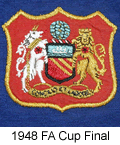 United adopted their lucky hooped change shirt as first choice. Later histories describe these as "cherry and white" but the club minutes of the time confirm that the FA had agreed to change the club's registered colours to "maroon and hoop" (sic). This was worn throughout the following season before the more familiar plain red shirts were reinstated for 1935-36.
In 1945, Matt Busby joined the club and built a succession of sides who carried all before them. United won the FA Cup in 1948 wearing a crest based on the coat of arms of the City of Manchester. This appeared again in the 1957 FA Cup final but was not otherwise used.
United adopted the new style of lightweight continental strip in 1955-56: some batches had sleeves with contrasting white cuffs while others were plain.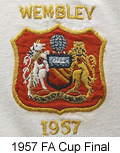
United were runners up in the League four times out of five before
they won the League Championship in 1952. In 1956 and 1957 a side made
up mainly of home grown young players known as the "Busby Babes"
took two successive Division One titles and, against the wishes of the Football League management committee, entered the European Cup where they wore variants of their usual strips. Their potential was cruelly cut
short on the 6th February 1958 when, returning from a European Cup tie
against Red Star Belgrade, the team's aircraft crashed at Munich airport,
killing twenty-two people, seven of them first team players. Remarkably,
a team of reserves reached the FA Cup final that year. Busby, who 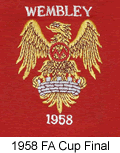 survived
the crash, set about building yet another team around the survivors.
survived
the crash, set about building yet another team around the survivors.
The crest worn in the 1958 FA Cup final gave rise to a story that it was chosen to suggest that United would rise, phoenix-like from the ashes of Munich but this is simply untrue. The eagle motif had recently been added to the city's municipal crest to represent Manchester's connection with ancient Rome.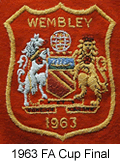
The Sixties side that featured Charlton, Denis
Law and George Best is generally considered one of the finest to have
represented the club. White socks were usually worn at home (occasionally red ones were used away from home). In the 1963 FA Cup final, United wore red socks to avoid a clash with Leicester City, who wore all-white. Red socks then became their first choice the following season. They won the FA Cup in 1963 were League Champions
in 1965 and 1967 and in 1968, they became the first 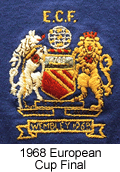 English side to win
the European Cup in a dramatic 4-1 win over Benfica at Wembley in extra
time. During this period the club's kit evolved gradually: the iconic black stockings with red and white tops were replaced with white ones. Red socks appeared occasionally in the 1964-65 and became the first choice the following season. In 1971 the stockings reverted to the classic black with red and white tops.
English side to win
the European Cup in a dramatic 4-1 win over Benfica at Wembley in extra
time. During this period the club's kit evolved gradually: the iconic black stockings with red and white tops were replaced with white ones. Red socks appeared occasionally in the 1964-65 and became the first choice the following season. In 1971 the stockings reverted to the classic black with red and white tops.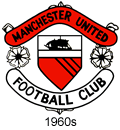
A distinctive club crest appeared on official documents during the 1960s but was never applied to the team's shirts. It featured the central motif from the city's coat of arms, the arms of the Grelley family (incorrectly coloured), first Barons of Manchester, below a sailing ship, symbolising trade and enterprise. Tim Ashmore points out that the two roses are, for some reason, not coloured red as one would expect for such a famous Lancashire team, but white.
In 1969, Busby retired as manager although he continued as a director for the next eleven years before becoming club president.
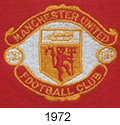 In 1970 the modern club crest was redesigned with a red devil as the centrepiece and the incongruous white roses replaced by footballs. It is thought that the name was coined by French newspapers who dubbed the Salford rugby league team Les Diables Rouges after a successful tour in 1934 and Busby adopted this as the club's official nickname (but in English, obviously). In the 1972-73 season this new crest appeared on the team's shirts for the first time.
In 1974, United were relegated to Division Two.
Ironically, in their final match against Manchester City, Denis Law, given
a free transfer by United, scored against his old side. They bounced back immediately
and in 1977 United beat Liverpool to win the FA Cup, wrecking their rivals
hopes of a treble. Since 1975 United have often worn black shorts with their red shirts when playing away 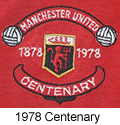 from home to avoid colour clashes.
For their centenary season in 1978-79, a modified crest was used. The previous version was reinstated the following season, which since Admiral took over in 1975, had had the ship embroidered in red rather than gold.
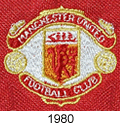 Adidas won the by now extremely lucrative contract as United's kit supplier in 1980 and made a subtle but sly modification the crest, adding a pair of football boots with their own trade mark three-stripe trim above the upper scroll. These were removed in 1992 when Umbro took over the contract, as was the white background.
In the 1980's, with Ron Atkinson in charge, United won the FA Cup in 1983 and 1985 but failure to break Merseyside's stranglehold on the championship led to Atkinson's dismissal and the appointment of Alex Ferguson, who had led Aberdeen to every honour available in Scotland.
 Ferguson's regime had a shaky start and he would
most likely have been sacked had the club not won the FA Cup in 1990.
He survived and, after signing the French genius Eric Cantona
from Leeds, United won the inaugural Premiership title in 1993,
Ferguson's regime had a shaky start and he would
most likely have been sacked had the club not won the FA Cup in 1990.
He survived and, after signing the French genius Eric Cantona
from Leeds, United won the inaugural Premiership title in 1993, 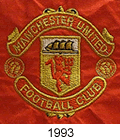 followed
by the League and FA Cup double in 1994. In 1995 United were runners up
in the League and FA Cup, repeated the double in 1996 and won the League
again in 1997. The 1998-99 season, however. surpassed all others: having
clinched their third double of the decade, United beat Bayern Munich in
dramatic fashion in the European Champions League final to secure a unique
treble and earn Ferguson a knighthood.
followed
by the League and FA Cup double in 1994. In 1995 United were runners up
in the League and FA Cup, repeated the double in 1996 and won the League
again in 1997. The 1998-99 season, however. surpassed all others: having
clinched their third double of the decade, United beat Bayern Munich in
dramatic fashion in the European Champions League final to secure a unique
treble and earn Ferguson a knighthood.
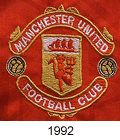
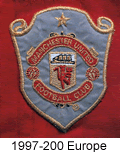 The club crest evolved in small steps during this period: the lettering changed from white to gold in 1993 and the ship also became gold. A different version was worn in European competition between 1997 and 2000 on the distinctive European kit.
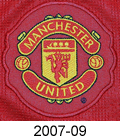
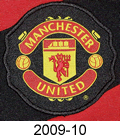
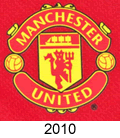
In 1998 a new version of the crest, optimised for digital reproduction, was introduced. A simplified legend now appeared out of the scrolls 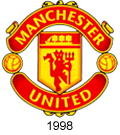 and the proportions were slightly altered. The omission of the words "Football Club" caused some consternation among supporters as it emphasised the vision of the owners to create a global brand at the expense of United's traditional identity as a club. Several different backgrounds have been used (some of which are illustrated here) but the basic design has remained unchanged until the time of writing (2015).
In 2001, United won the Premiership title for the
third successive season. Ferguson announced his retirement in 2002 and
then allowed himself to be persuaded to stay on. 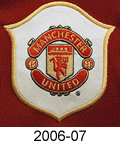 In 2003 United clinched
their fifteenth League title and their eighth under Ferguson. Far from
retiring, the combative Scottish manager built another side featuring players such as Wayne Rooney, Cristiano Ronaldo and life long United stalwarts Ryan Giggs and Paul Scholes that won the
Premier title in 2007.
In 2003 United clinched
their fifteenth League title and their eighth under Ferguson. Far from
retiring, the combative Scottish manager built another side featuring players such as Wayne Rooney, Cristiano Ronaldo and life long United stalwarts Ryan Giggs and Paul Scholes that won the
Premier title in 2007.
 To mark the 50th anniversary of the Munich tragedy, in February 2008, the club organised a week of special events including a memorial service held on the 6th February and culminating in a derby match against Manchester City in which the United players wore an exact replica of the kit worn by the Busby Babes half a century before. United went on to clinch the Premier League title on the final day of the season after their closest rivals, Chelsea, had gone into the final round of matches level on points. The two clubs met once again on 21 May in the UEFA Champions League final, played in Moscow. After a dramatic match, United won the trophy in a penalty shoot-out, an achievement that confirmed Alex Ferguson as one of the world's all-time great managers.
 Since May 2005 the club has been controlled by American businessman Malcolm Glazer who bought up the 75% of shares needed to de-list the club from the Stock Market and turn it back into a private company. Glazer borrowed the cash needed and subsequently loaded these debts onto the club (which essentially means that the club itself financed the takeover). From being one of the wealthiest clubs in the world, United became the
  most indebted: in January 2010 their debts totalled £760m and around £210m had been paid out in interest.
On 14 May 2011 United drew 1-1 at Blackburn to clinch their 19th league title (their 12th in the Premier League), beating Liverpool's record of 18 wins.
The pattern on the 2012-13 home shirt represented gingham, a reference to the days when Manchester was the global centre of the cotton industry.
After United won the 2012-13 Premier league title in 2013, Sir Alex Ferguson announced his retirement after 26 years in charge. His record of 38 trophies, which included 13 Premier league titles and two Champions' League wins, made Ferguson the most successful manager in the history of British football.
Ferguson's successor, David Moyes, was sacked after a poor season in which United not only were without a trophy but also failed to qualify for Europe for the first time in 24 years. In his place the coach of the Dutch 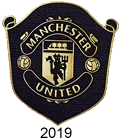 national team, Louis van Gaal would replace him with Ryan Giggs, finally retired from playing, as his assistant.
In 2015 Adidas took over as United's technical sponsor with a contract worth a record £750m over ten years.
To mark the 20th anniversary of their historic treble in 1999 Adidas produced a special strip with a commemorative crest based on the version worn in the Champions League final in Barcelona. In 2020-21 United reached the Europa League Final against Villareal. The match ended 1-1 and in a remarkable penalty shoot-out, United eventually lost 11-10.
Although eclipsed in the Premier League by their rivals, Manchester City, United did win the EFL Cup in 2022-23 and the FA Cup a year later.
With acknowledgement to the research of Paul Nagel and Tim Ashmore.
You are welcome to Contact Me with corrections and additions.
Sources
- (a) Encyclopedia of Manchester United
- (b) Manchester United Official Website
- (c) Sporting Heroes
- (d) Football Focus
- (e) David Hamilton
- (f) Association of Football Statisticians - provided by Pete Wyatt
- (g) Gav Lloyd
- (h) Pride of Manchester
- (i) There’s Only
One United (Geoffrey Green) provided by Paul Nagel | Buy from Amazon.co.uk
- (j) The United Alphabet
(Garth Dykes 1994) provided by Paul Nagel | Buy from Amazon.co.uk
- (k) David King
- (l) Robin Johnson
- (m) Pete's Picture Palace
- (n) Christopher Worrall
- (o) Paul Nagel - HFK Research Associate
- (p) Association of Football Statisticans (provided by Alex Howells)
- (q) Manchester United (Percy M Young 1960 Heinman) provided by Paul Nagel
- (r) The Gibson Guarantee (Peter Harrington 1994 Imago Publishing) provided by Paul Nagel
- (s) Alexander Howells
- (t) Kevin Watts
- (u) Simon Monks
- (v) Tim Ashmore's History of United's kits is a comprehensive guide to the club's early kits.
- (w) Kjell Hanssen
- (x) Alan Brennan
- (y) See unitedkits.com, a comprehensive season-by-season guide to United's kits with a wealth of supporting detail, put together by regular HFK contributors, Paul Nagel and Tim Ashmore. These include graphics of all the variant kits worn by the team. Tim has recorded a detailed history of the club crest at RedCafe.net.
- (z) Brian Landamore
- (A) Graham Curel
- (B) Keith Ellis

+ Kit graphic by Daniel Stoker
* The Admiral branding first appeared on shirts in January 1976: both branded and unbranded shirts were then used until the 1978-79 centenary kit was introduced.
Crest images supplied by Tim Ashmore from photographs of match-worn shirts. Crests are the property of Manchester United FC.