





Kit History

1874-1878 a o r B M
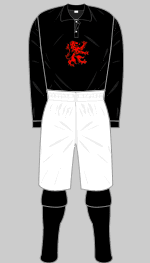
1878-1879 o
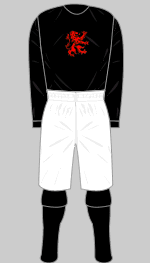
1879-1880 1 b o y B
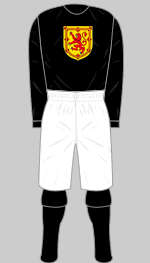
1879-1880 2 y
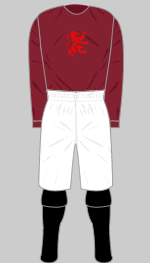
1880-1882 y
Jan 81-Feb 84 a o x B
March 1884 o B L
1884-1885 I

1885-1886 o K U

1885-Nov 1886 y B J V
Nov 1886-1888 c o y B
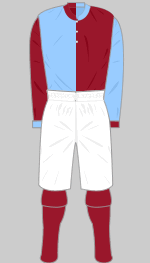
1888-1890 B L
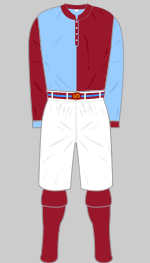
1890-1892 b m o B

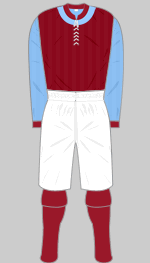
1892-1893 1 L
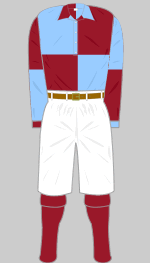
1892-1893 2 Q R
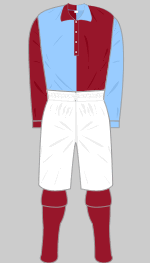
1893-1894 b o d
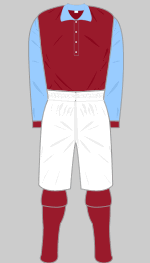
1893-1894 b h o
1894-1900 b h i B
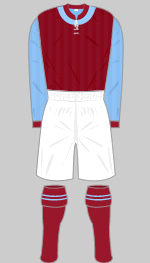
1901-1905 b h i j A
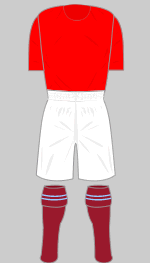
1900-1911 alt y B P S
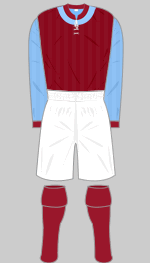
1905-1907 C D
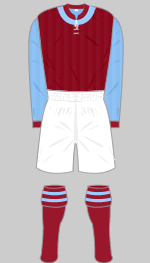
1907-Dec 23 b h i z B
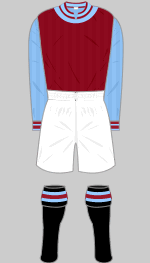
Jan 1924-1935 b B
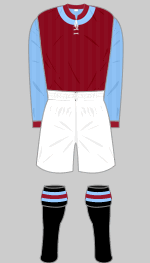
1935-1936 b
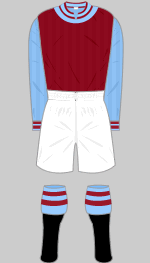
1936-1944 b z D
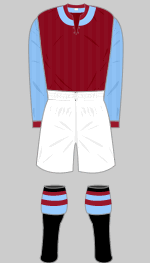
1946-1955 b i s D
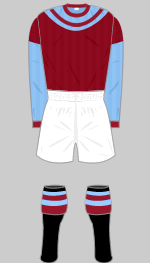
1955-1956 e G
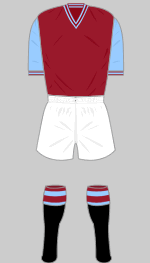
1956-Jan 1957 B
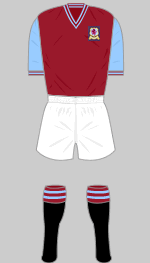
Jan-May 1957 b i
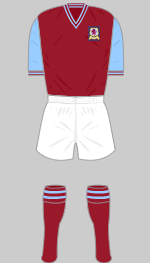
1957-1958 b i
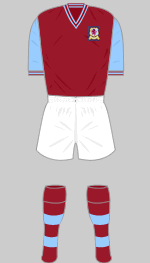
1958-1959 D
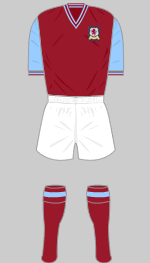
1959-1961 b
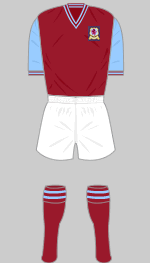
1961-1963 f l
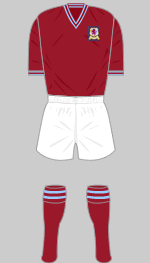
1962-1963 alt T
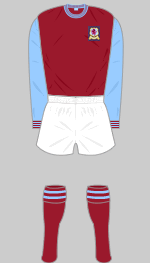
1963-1965 l
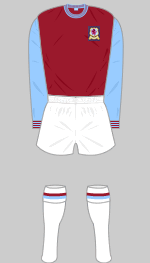
1965-1966 l
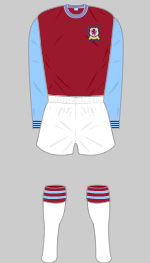
1966-1968 l
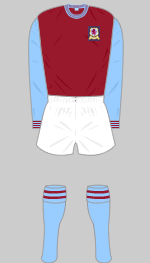
Aug 68-Jan 69 i l
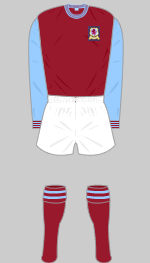
Feb-May 1969 B

1969-Jan 70 l B
Jan-May 1970 B
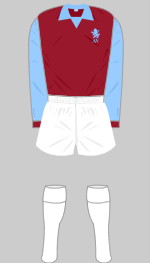
1970-1971 q
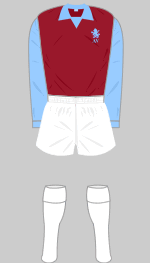
1971-1973 i l
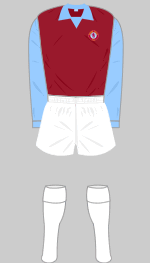
1973-1974 u
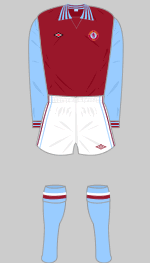
1974-1976 g O

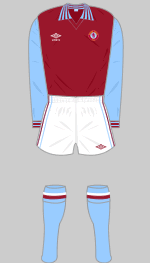
1976-1981 g


1981-1982 g i v
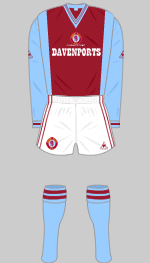
1982-1983 g t v
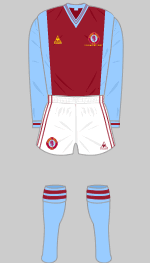
1982-1983 Eur E
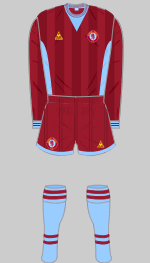
1983-Feb 1984 H
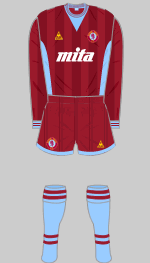
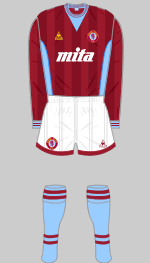
1984-1985 g k
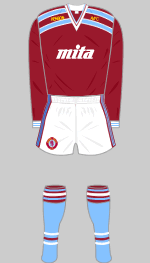
1985-1986 1 g v F

1986-1987 2 g v F

1986-1987 v F
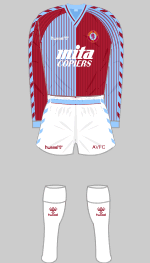
1987-1988 n v

1988-1989 g n v

1989-1990 g
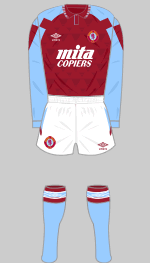
1990-1992 g
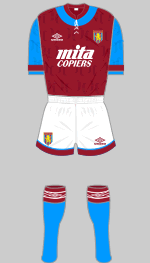
1992-1993 g
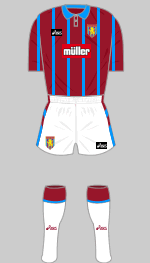
1993-1995 g
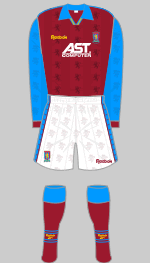
1995-1997 g
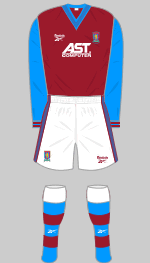
1997-1998 k

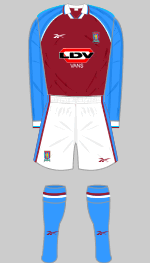
1998-1999 g

1999-2000 g
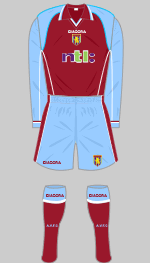
2000-2001 h
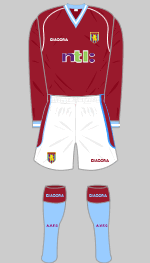
2001-2002 p w
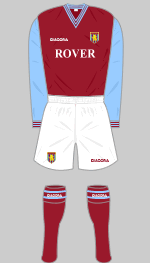
2002-2003 h
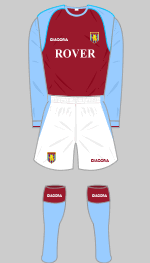
2003-2004 h
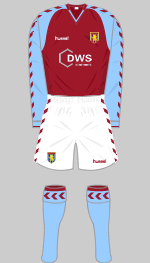
2004-2005 h
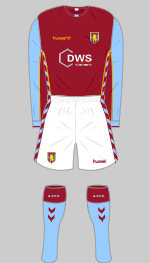
2005-2006 h
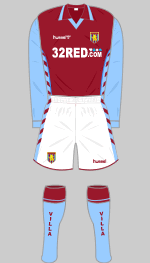
2006-2007 h
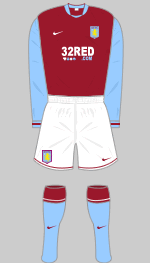
2007-2008 h
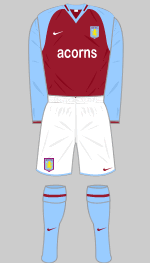
2008-2009 h
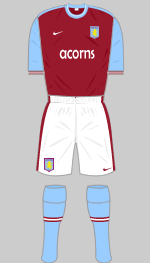
2009-2010 h
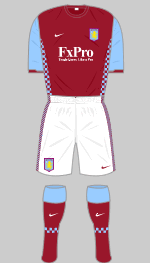
2010-2011 h
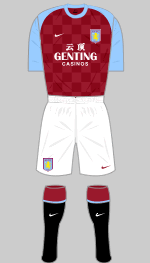
2011-2012 h

2012-2013 h
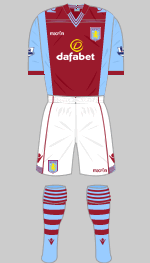
2013-2014 h
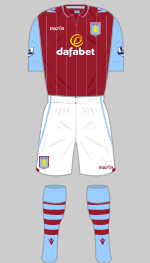
2014-2015 h
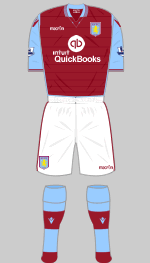
2015-2016 h
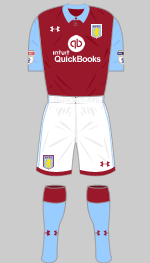
2016-2017 h
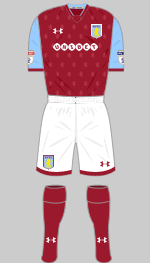
2017-2018 h
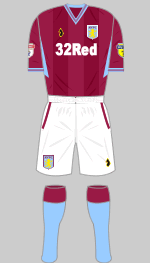
2018-2019 h
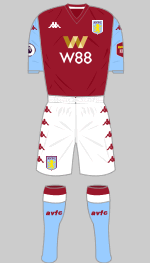
2019-2020 h
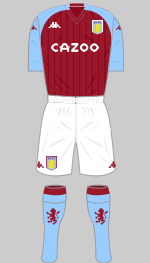
2020-2021 h
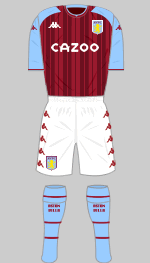
2021-2022 h
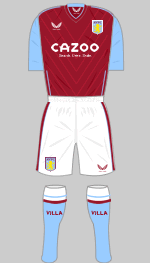
2022-2023 h
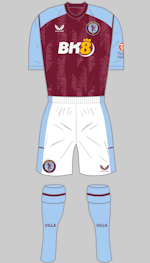
2023-2024 * h
Background
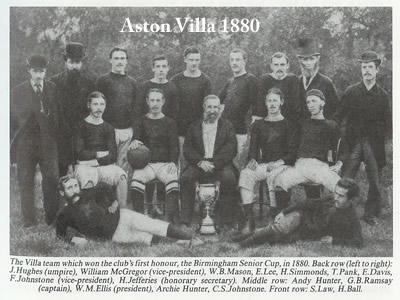 The
club was formed by members of the cricket team attached to the Aston Villa Wesleyan Methodist Chapel in Birmingham who wanted to establish a winter activity. After four of their number watched a game of rugby the members decided that the association rules were more to their taste.
The
club was formed by members of the cricket team attached to the Aston Villa Wesleyan Methodist Chapel in Birmingham who wanted to establish a winter activity. After four of their number watched a game of rugby the members decided that the association rules were more to their taste.
Over time Villa developed strong ties with the large Scottish community who were drawn to the city’s burgeoning engineering industry. One Scot in particular, businessman, William McGregor, played an enormously influential role in the club and the professional game. McGregor was a teetotaler and an evangelist Methodist who wanted to do something to help the city. He had seen his first football match in Scotland at the age of eight and a couple of years after Aston Villa was formed he offered to help. A natural organiser and businessman, he was soon a vice-president of the club, and became Chairman at the time of Villa’s first organisationally traumatic period between 1885 and 1887, but which culminated in the club winning the FA Cup for the first time. It was at McGregor’s instigation that the Football League was formed in 1888 when the game threatened to fall into disrepute and collapse owing to fixtures not being kept to.
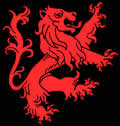 The team's first colours were described as "scarlet and royal blue stripes" (i.e. hoops - vertical stripes did not appear until the 1880s). In 1878 they purchased a set of black shirts emblazoned with the Scottish lion rampant. William McGregor actually went to Scotland to purchase the lion motifs and they were subsequently sewn on by the sister of the club secretary (ref: The Aston Villa Chronicles). The following season jerseys replaced the original shirts but the lion motif faded badly in the laundry. Charles S Johnstone, an influential player, interviewed late in life said, "Our lion had no chance with the washing lady! He became pale and anaemic so Mac (William McGregor) was deputed to send to Scotland for thirteen lions on shields proper, which could be attached and detached at will....When they were duly attached you could hardly see the man for the lion - we were each as self-conscious as a bride in a wedding dress. We went on the field but the gorgeous lion got us down. We had a most awful whacking and the lion was relegated to the club notepaper and flags."
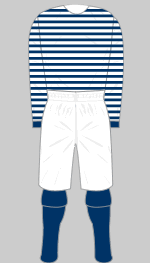
Lee Gauntlett has found a reference in the club handbook from 1990-91 that states, "Villa wore new maroon jerseys with a lion rampant emblazoned across their chests" in the 1880-81 season. For their game against Heart of Midlothian on New Years' Day 1881 Villa wore navy and white hooped jerseys and there is evidence that these colours were worn at least until January 1884. A contemporary press cutting describes Villa as "the Blacks" in an FA Cup tie with Notts County on 12 February 1881.
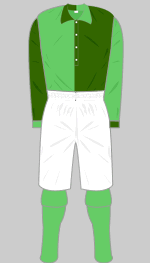
Lee Gauntlett has also found a reference in the Birmingham Gazette dated 5 April 1884 that describes Villa playing against West Brom, "in a brand new and pretty uniform." Bernard Gallagher has established that these were new halved shirts in two shades of green. These had been chosen by the club's committee in February and were worn for the first time at Perry Bar against Wednesbury Town on March 24 1884.
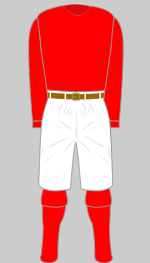
The Preston Herald (13 August 1884) reported that, "The Villains....appeared in beautiful red jerseys and white knickers" against Blackburn Rovers.
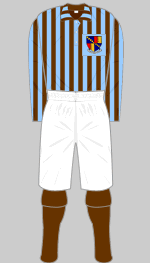
The situation in 1885-86 is confusing. The Bolton Daily Chronicle on 31 August 1885 describes Villa playing in "black and white bars...in substitution for the maroon which formerly distinguished them." In January 1886 the Cricket & Football Field reported that Villa played in "coral and maroon" against Accrington. A printed favour that came to light in 2025 confirmed that "coral" was indeed coral pink. The implication is that the coral and maroon tops were introduced at some point in the 1884-85 season and were used alongside the black and white hooped jerseys during 1885-86. In his memoir "Triumphs of the Football Field" narrated by the former Villa captain, Archie Hunter and published in 1890, Hunter stated that in November 1886 "we decided to put aside the piebald uniform, which was inartistic and never popular and donned...the light blue and cardinal 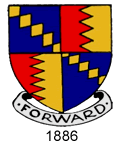 vertically striped jerseys which afterwards became so well known." By "piebald" it now seems clear that Hunter was referring to the hooped jerseys. The switch is confirmed by contemporary press reports and the club minute book.
Six of eleven players in the FA Cup winning side in 1886-87 that wore these tops had the Birmingham coat of arms of the time emblazoned on their shirts. It is now known that this was the badge of the Birmingham & District FA awarded to players who had been selected for a representative match against Sheffield Association a month earlier
On June 2 1888 members voted to adopt new colours of claret and blue "quarters" (ie halved). In the early 1890s plain claret tops with contrasting light blue sleeves appeared from time-to-time. In 1892-93, Villa adopted the iconic woolen jersey with a distinctive contrasting neck band for the first time but quartered shirts were also worn that season. The iconic contrasting became Villa's regular first choice from 1894. This style would be copied by many English clubs. Long after other professional clubs switched to wearing cotton shirts, Villa continued to wear these distinctive woolen jerseys, with subtle vertical ribbing.
Ollie Whateley, who was Villa’s third England international and a graphic artist by trade claimed to have designed Villa's claret and blue colours but it is unclear whether he was referring to the halved or contrasting sleeve design.
By the end of the nineteenth century Aston Villa were established as aristocrats of the English game with five League Championships along with three FA Cup triumphs. In 1896/7 they also achieved the accolade of becoming the second side to do the League and Cup double.
There is a puzzling reference in the Birmingham Gazette of 30 September 1901 (researched by Lee Gauntlett) that states Villa were wearing red jerseys "to deflect the glare of the sun." The match was against Small Heath in the Birmingham Cup but John Lerwill has confirmed that Villa did indeed wear red tops in some League matches between 1901 and 1908 while Richard Essen has found press reports that confirm they were worn untill 1911. Indeed, William McGregor frequently referred to this in his 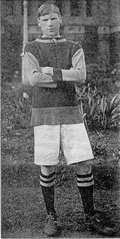 newspaper column and expressed concern that Villa might drop their iconic claret/blue tops. It transpires that these were lightweight alternatives to the usual heavy woollen jerseys that became unbearable in hot weather. In October 2021 photographs were found by Jon Farrelly that not only confirmed these alternative tops were worn in October 1901 but also that they had short sleeves.
The photograph of Frank Moss (October 1914) on the right shows just how thick Villa's woollen jerseys were and reveals that they also had a blue "skirt" that was normally tucked into the players' knickers.
During the Edwardian era Villa continued to be a major force, winning the championship once more in 1910 and taking the FA Cup in 1905 and 1913.
Success was harder to achieve after the Great War, an FA Cup win in 1920 providing their only major trophy. In January 1924 a modified design was introduced with a high crew neck with two light blue bands, repeated at the cuffs. These jerseys were originally laced at the throat but the lacing was quickly discarded or lost in the laundry and the neckline became stretched, giving rise to a scruffy appearance, especially when the neckline flopped over on itself. The older, single hooped neckline re-emerged several times but the high, double banded neck did not disappear until the end of the 1955-56 season.
The 1930s were a period of relative decline and the club even suffered the humiliation of a brief stay in the Second Division (1936-1938).
 With the introduction of the modern, "Continental" strip made from cotton in 1956, the club crest appeared on their shirts for the first time during their FA Cup run, which ended with them winning the cup for the seventh time. It featured the traditional Scottish lion
 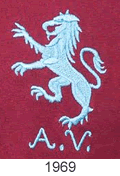 rampant that had first appeared in 1878.
This FA Cup success proved a brief flash in the pan and by 1970 the club found themselves in the Third Division. Before he was sacked towards the end of their relegation season, the charismatic Tommy Docherty introduced a radical new design of strip and a simplified crest. The innovative collars with v inset became de rigueur throughout the League. This unusual strip was dropped after Docherty's departure.
 With Ron
Saunders at the helm and yet another new crest (introduced in 1973), the late Seventies brought a return to Division
One (1975) success in the League Cup twice (1975 and 1977) and in 1981,
Villa won the League for the first time in 70 years. The following season, after a falling-out with the club's chairman, Saunders was replaced by his assistant, Tony Barton who
led Villa to victory in the European Cup Final followed by the European Super Cup (contested between the European Champions and European Cup Winners' Cup) the following season.
With Ron
Saunders at the helm and yet another new crest (introduced in 1973), the late Seventies brought a return to Division
One (1975) success in the League Cup twice (1975 and 1977) and in 1981,
Villa won the League for the first time in 70 years. The following season, after a falling-out with the club's chairman, Saunders was replaced by his assistant, Tony Barton who
led Villa to victory in the European Cup Final followed by the European Super Cup (contested between the European Champions and European Cup Winners' Cup) the following season.
These achievements marked the high point in Villa's career and in 1987, they were relegated to the Second Division. Under Graham Taylor, they bounced straight back and finished as runners-up in 1990. Two years later they became founder members of the Premier League, wearing a striking strip inspired by the iconic hoop-neck jerseys first seen in 1890 and bearing a rather more traditional crest.
In the Nineties, Aston Villa were inconsistent in the league but did win two League Cups, regularly qualified for Europe and were beaten FA Cup finalists in 2000.
 In 2006, following the acrimonious departure of manager, David O'Leary, Villa's chairman, Doug Ellis decided to retire on health grounds and sold his 38% stake in the club to Randy Lerner, owner of NFL franchise team, Cleveland Browns. Martin O'Neill was appointed as manager and sweeping changes made behind the scenes, which included yet another redesigned crest, which appeared in 2007. A small white star represented Villa's European Cup win.
In 2008 Villa broke new ground when they wore the logo of Acorns Children's Hospice on their shirts in place of the usual commercial sponsorship.
 In 2013, following the trend for retro-inspired kits, Macron designed a home strip based on the iconic Le Coq Sportif version worn when Villa won the European Cup 30 years earlier.
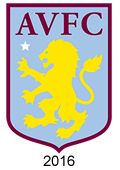
In April 2016 the club revealed that the crest would be modified for the following season. The famous lion rampant regained his claws (removed in 2007) and the word "Prepared" was to be dropped. The new crest appeared in the Championship after the team finished 2015-16 bottom of the Premier League. The team returned to the top level in 2019 via 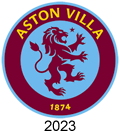 the play-offs.
In 2022 the club consulted with supporters over the design of a new crest. The winning version attracted the support of 77% of those who voted but was 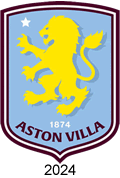 dropped at the end of the season because did not have the impact that had been hoped for. After another hastily organised consultation the new design was revealed ahead of of the 2024-25 season, looking remarkably similar to the earlier versions. One hopes the management considered this money and energy well spent.
My thanks to John Lerwill, Villa's official historian, and Bernard Gallagher for adding valuable detail to the Victorian period covered in this article.
Sources
- (*) Graphic by Daniel Stoker
- (a) The Complete Encyclopedia of Aston Villa
- (b) The Aston Villa Collection
- (c) Astonbrook Through Aston Manor website dedicated to the history of Aston with some splendid Victorian photographs.
- (d) The Villa Park Encyclopedia: An A-Z of AVFC (Mainstream Publishing 1997)
- (e) Sheffield United FC - Images of Sport (f) Ipswich Town FC - Images of Sport
- (g) Sporting Heroes
- (h) Aston Villa Official Website
- (i) Football Focus
- (j) Bury FC - Images of Sport (Peter Cullen 1998)
- (k) True Colours (John Devlin 2005)
- (l) Forever Villa (David Instone 2005)
- (m) Association of Football Statisticians - provided by Pete Wyatt
- (n) David King
- (o) Bernard Gallagher
- (p) Derek Hart
- (q) Steve Morris
- (r) Claret & Blue magazine provided by Martin Kender
- (s) Playfair Football Annual 1948-49 provided by Alexander Howells
- (t) Brian Melmore
- (u) Malcolm Pugh
- (v) Christopher Worrall
- (w) David Heaton
- (x) Wikipedia
- (y) Lee Gauntlett
- (z) Simon Monks
- (A) British Film Institute archive (Youtube)
- (B) The Athletic News (May 1886) submitted by John Lerwill (Official Aston Villa Historian)
- (C) The Lordprice Collection
- (D) Keith Ellis
- (E) Ettore Bucciarelli
- (F) Mark McDonagh
- (G) Grandad's Football Blog
- (H) Mark Hughes
- (I) Preston Herald (13 August 1884) submitted by Brian Webb.
- (J) The Triumphs of the Football Field narrated by Archie Hunter (Birmingham Weekly Mercury 1890)
- (K) The Cricket and Football Field (23 January 1886) submitted by Lee Gauntlett
- (L) The Claret & Blue Blog by Bernard Gallagher.
- (M) Charles Alcock's Football Annual 1877 & FA Handbook 1877-78 submitted by Bernard Gallagher
- (N) Charles Alcock's Football Annual 1878 & 1880 submitted by Bernard Gallagher
- (O) Tony Sealey
- (P) Middlesbrough Daily Gazette (9 Oct 1909) & West Sussex County Times (10 Sept 1910) submitted by Richard Essen
- (Q) Penny Illustrated (18 March 1893) submitted by Lee Gauntlett
- (R) Aston Villa FC From the Archives
- (S) The Illustrated Sporting & Dramatic News (3 October 1901) submitted by Jon Farrelly
- (T) Steve Morris
- (U) Phil Martin
- (V) The Bolton Daily Chronicle (August 31 1885) submitted by Lee Gauntlett
Crests are the property of Aston Villa FC.