
Hartlepool
United
Formed 1908
Founder member of Third Division (North) 1921. Relegated to the National League 2017
Promoted to League Two 2021
Kit History
Hartlepools United
1908
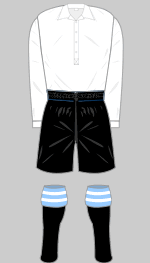
1908-1911 a j q A
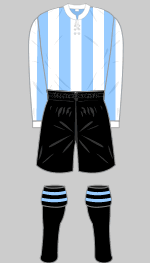
1912-1920 q
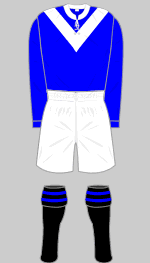
1921-1922 k q w
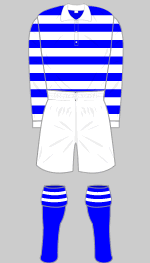
1922-1923 w z
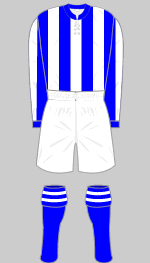
1924-1926 w
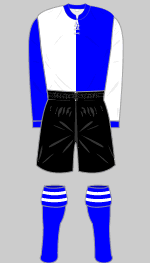
1926-1927 w
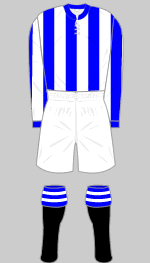
1931-1932 k w v
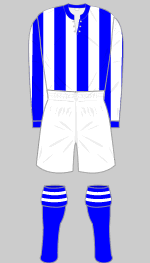
1932-1935 k q w
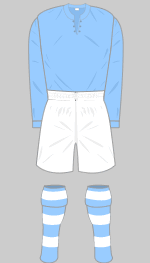
1935-1936 u w
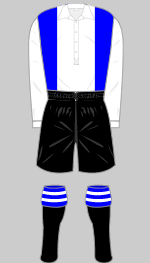
1936-1937 k
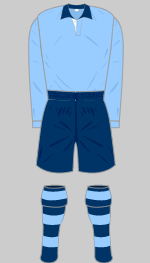
1937-1939 q

1946-1947 k
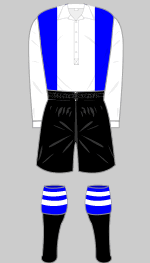
1947-1952 d k
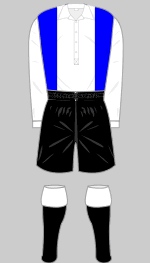
1952-1953 A
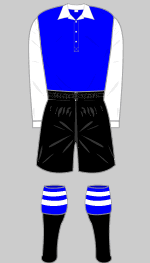
1953-1954 k w
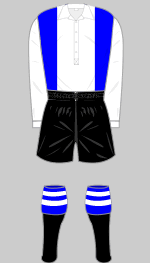
1955-1956 d k
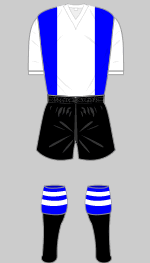
1956-1957 k
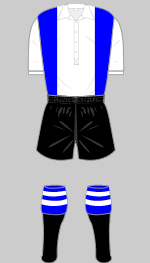
1957-1958 k
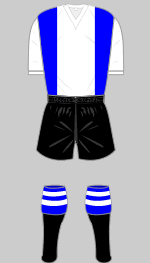
1958-1959 k
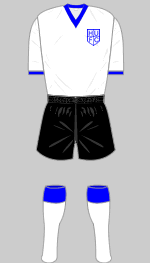
1959-Jan 1960 k n w
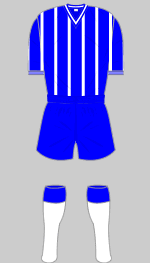
Jan 1960-1962 e l q w
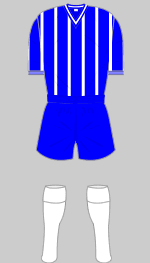
1962-1963 v
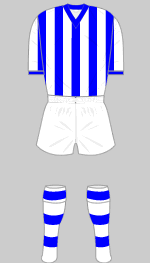
1963-1965 w
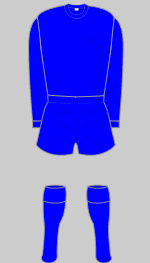
1965-1966 f q v

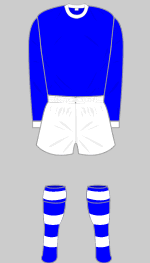
1966-1967 v
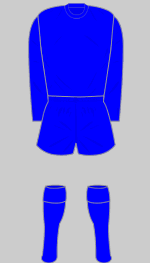
1967-1968 w
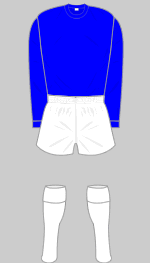
1968-1969 c w
Hartlepool
1968
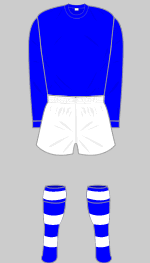
1969-1971 m w
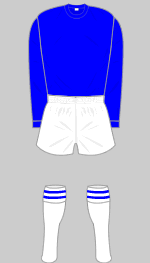
1971-1972 g w
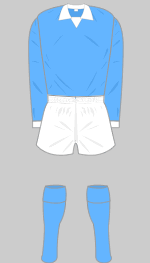
1972-1973 c w
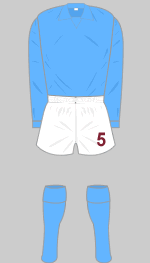
1973-1974 w j
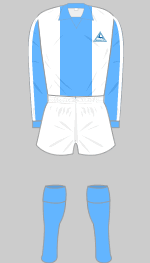
1974-1975 1 q w
1974-1975 2 j
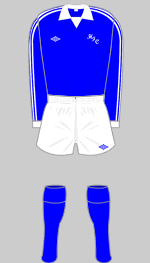
1975-1977 f s w
Hartlepool United
1977
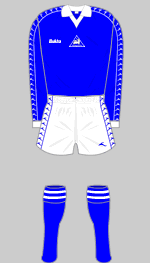
1977-1978 f s
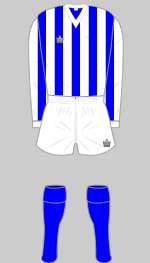
1978-1980 j q s w
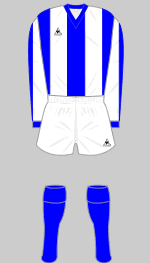
1980-1981 j q s w
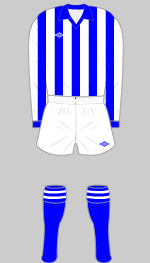
1981-1982 t w
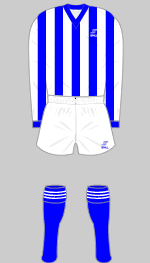
1982-1983 w
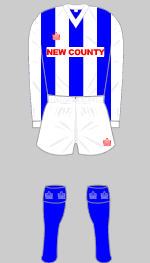
1983-1984 h s w
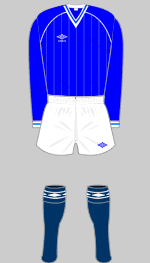
Aug-Dec 1984 q w
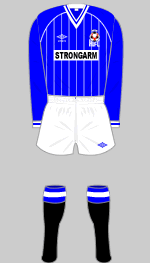
Jan-April 1985 j w
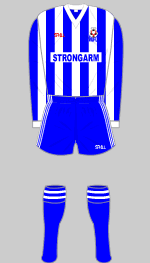
1985-1987 a j w
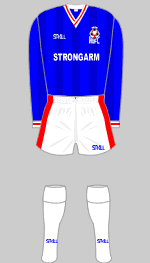
1987-1988 q
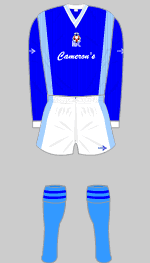
1988-1989 m q w
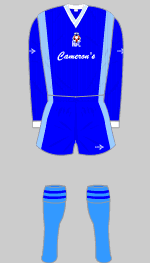
1989-1990 x
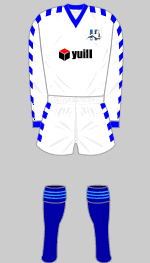
1990-1991 a o p w
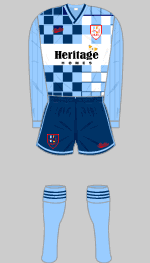
1991-1992 b i w
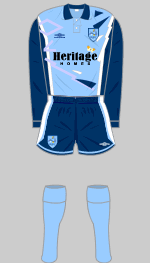
1992-1993 p w
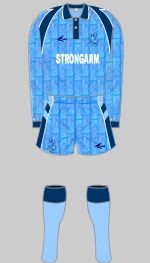
1993-1995 e i q r w
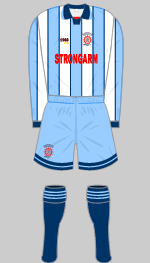
1995-1997 e q r w
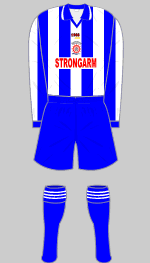
1997-1999 c p r w
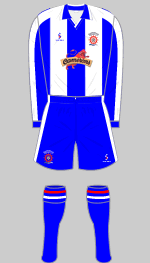
1999-2000 e r
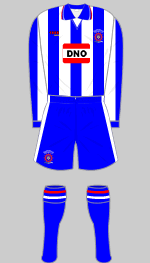
2000-2002 e o y
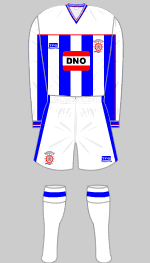
2002-2003 e o r
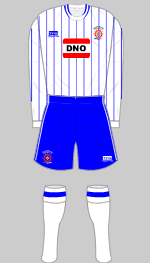
2003-2004 e o r
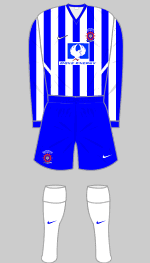
2004-2006 c r
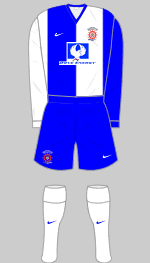
2006-2008 a
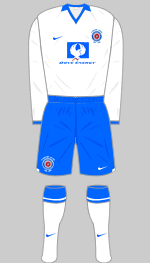
2008-2009 a
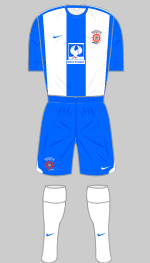
2009-2011 a
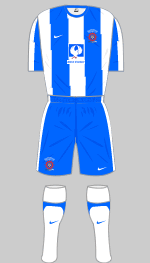
2011-2013 a
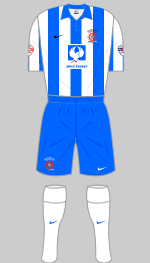
2013-2014 a
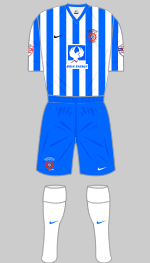
2014-2015 a
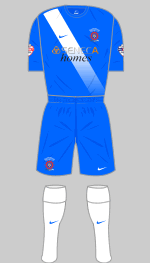
2015-2016 a
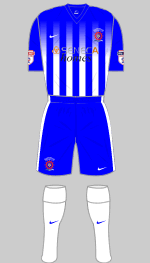
2016-2017 a
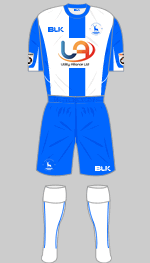
2017-2018 a
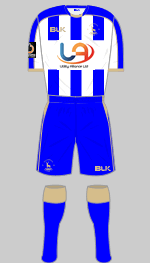
2018-2019 a
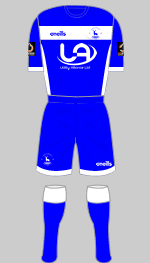
2019-2020 a
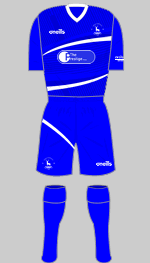
2020-2021 a
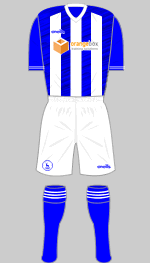
2021-2022 a
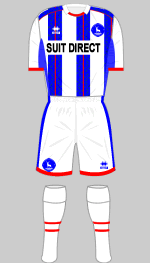
2022-2023 a
Background
 In 1881, West Hartlepool AFC
was formed; they joined the Northern League around 1900 and went on to
win the FA Amateur Cup in 1905.
In 1881, West Hartlepool AFC
was formed; they joined the Northern League around 1900 and went on to
win the FA Amateur Cup in 1905.
In 1886, the West Hartlepool Rugby Club was founded and they built what became known as the Victoria Stadium in an old limestone quarry. When this club folded in 1908 a new limited company was formed to take over the ground and field a professional association football club. Despite being located in West Hartlepool, and over the objections of the incumbent amateur club, the new outfit took the name of Hartlepools United, representing the twin towns of Hartlepool and West Hartlepool. For a short period the two co-existed and even shared the same ground until 1910 when West Hartlepool AFC was wound up and their assets passed to the professional club.
Hartlepools United acquired the unusual nickname of “The Monkey Hangers” after a grisly story from the Napoleonic Wars of the early 19th century. Legend has it that a French vessel foundered in a storm off the Hartlepool coast, the only survivor being a monkey, washed up on shore and found by local fishermen. Unfamiliar with what a French sailor might look like and unable to communicate with it, the fishermen hung the unfortunate beast from the mast of one of their boats as a spy. Today, the club has a monkey as its mascot.
During the First World War, the Victoria Ground was twice damaged by enemy action, the first a naval bombardment and later on by zeppelin raid, causing the club to build a temporary wooden stand. For many years afterwards, the board pursued a claim for damages against the German government without success.
In 1921, having finished in the top half of the North Eastern League, “Pools” were invited to join the Football League’s new Northern Section of the Third Division. During the close season a Workington player was transferred to the club in exchange for £10 and a box of kippers.
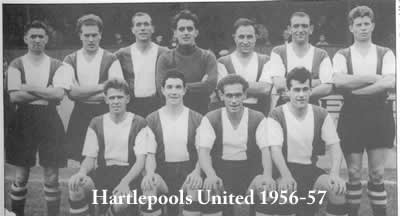
Prior to the outbreak of the Second World War the team made little impression and were forced to seek re-election on three occasions.During the late 1940s and throughout the 1950s there was still little for the fans to cheer about although they did enjoy some stirring FA Cup ties, most notable of which was a narrow 3-4 defeat by Manchester United’s “Busby Babes” in 1957.
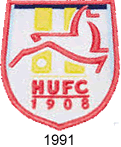
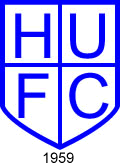 The first time that a crest appeared on 'Pools' shirts was the 1959-60 season when a simple shield bearing the club's initials was worn on the white shirts that season. This was dropped in January 1959 or thereabouts when a new set of blue and striped shirts were adopted.
That Pools survived the early 1960s is something of a miracle, as they applied for re-election on five successive occasions between 1960 and 1964. They were rescued by the young Brian Clough who, as manager, brought in Peter Taylor from Burton Albion as his assistant. Clough famously visited every pub in the two towns to raise money (and, no doubt, enjoying a few free pints on the way.) Before Clough and Taylor went on to make history at Derby County and later Nottingham Forest, they built a side that won promotion for the first time in 1968.
 In August of 1968 the twin towns were amalgamated
and to mark the occasion the club changed its name to Hartlepool FC. They
could not survive in the higher level, however, and after a single season
they were relegated back to the Fourth Division. It would be more than
20 years before the club won promotion a second time and six times they
In August of 1968 the twin towns were amalgamated
and to mark the occasion the club changed its name to Hartlepool FC. They
could not survive in the higher level, however, and after a single season
they were relegated back to the Fourth Division. It would be more than
20 years before the club won promotion a second time and six times they
 to go cap in hand to the League AGM to ask for re-election.
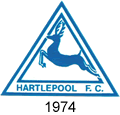
In 1974 a crest appeared once again, a leaping hart within a triangle above the new club name. The motif was taken from the official crest of the newly enlarged town, which featured a hart at bay above a pool of water (a 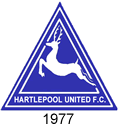 typical heraldic pun). The team were photographed prior to the start of the season in their new kit with the crest but it is not clear if this was worn in the league and by November they were back in the plain lightish blue shirts worn in 1973-74.
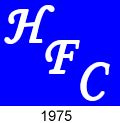
 The leaping hart badge was replaced the following season by a simple HFC monogram but was adopted once again in 1977, reversed out on a blue background with the new title of the club, Hartlepool United, added. Between 1978 and 1985 the team played in shirts without a crest although the 1977 crest badge did appear on the cover of match programmes until 1980 when it was replaced by a rather crudely drawn circular version.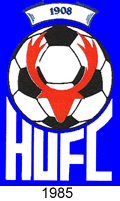
In 1985, following the Bradford fire disaster, 'Pools' 60 year-old “temporary” wooden stand was finally demolished. That same year a new, very contemporary crest was designed and was worn for the next five seasons.
In 1989 former Spurs star, Cyril Knowles, was appointed
manager and built the club’s second promotion winning team. Tragically,
Knowles died of a brain tumour shortly before the club won promotion in
1991. This success signaled an extraordinary burst of creativity in the
design of the club's strips. All the various shades of blue previously
worn were 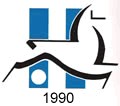 combined in the chequered kit of 1991-92. The badge of this period, first worn in 1990 was an even more modern, almost abstract interpretation of the traditional hart theme. Several variants appeared with the club's initials over the next few seasons.
 In January 1993 the club played Crystal Palace in an FA
Cup Third Round tie with a winding up order hanging over them. They were
rescued by a local business man, Harold Hornsey but the new regime could
not stop them from being relegated in 1994 to the
In January 1993 the club played Crystal Palace in an FA
Cup Third Round tie with a winding up order hanging over them. They were
rescued by a local business man, Harold Hornsey but the new regime could
not stop them from being relegated in 1994 to the 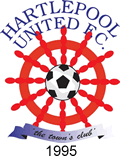 new Third Division (formerly
the Fourth) where they resumed their traditional struggle to avoid finishing
in the bottom four. Hornsey oversaw a £2m investment in the Victoria Ground that included the building of two new stands and ran a competition in 1995 to design a new club crest that would represent 'our town.' The winning entry celebrated the twin town's maritime connections with a central motif of an old fashioned ship's helm with the motto "The Town's Club" underneath.
new Third Division (formerly
the Fourth) where they resumed their traditional struggle to avoid finishing
in the bottom four. Hornsey oversaw a £2m investment in the Victoria Ground that included the building of two new stands and ran a competition in 1995 to design a new club crest that would represent 'our town.' The winning entry celebrated the twin town's maritime connections with a central motif of an old fashioned ship's helm with the motto "The Town's Club" underneath.
Having stabilised the club's finances and restored their reputation in the town, Hornsey sold his interest to an Aberdeen based
company, Increased Oil Recovery Ltd. Despite local skepticism about IOR’s intentions,
Hartlepool have been resurgent in recent times. With more than £2m
invested in ground improvements, they reached the play-offs three times
in succession (1990-2002) before 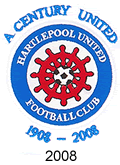 winning automatic promotion in second
place in 2003. Against all expectation they continued to challenge
for promotion, reaching the play-offs again in 2004 and 2005 before relegation
in 2006 took the 'Pool back into the basement, now known as League Two.
winning automatic promotion in second
place in 2003. Against all expectation they continued to challenge
for promotion, reaching the play-offs again in 2004 and 2005 before relegation
in 2006 took the 'Pool back into the basement, now known as League Two.
For their centenary season, 2008-09, the team reverted to their original white shirts before returning to their more familiar stripes (generally standard Nike templates).
 Hartlepool seemed bound for relegation to the National League (previously the Conference) in 2014-15. Ten points adrift in January newly appointed manager Ronnie Moore steered the team to safety in the penultimate match of the season. The owners, Ken Hodcroft, having lost the confidence of supporters sold the club to Peter Harris in December 2014 but the takeover fell through
  after Harris was charged with fraud and Hodcroft continued as chairman. In 2017, Hartlepool lost their place in League Two and were relegated to the National League.
A new badge was introduced in June 2017 ostensibly because the complexity of the previous version made it impractical to reproduce digitally. There was also some question about the the relevance of the ship's wheel to the club's heritage so the new version revived the hart that first appeared in 1974, seen standing on two  horizontal bands that represent water: hart-le-pool.
In early 2018 HMRC took out a winding up order over unpaid taxes but the club was saved after a young supporter, Rachel Cartwright set up a fund-raising campaign and paid off the tax bill. However, Hartlepool remained on the brink with debts increasing by £130,000 every month. In April 2019 local businessman, Raj Singh, and Sky Sports presenter, Jeff Stelling, took over the club. The takeover was not universally welcomed as Singh had previously driven Darlington FC effectively into liquidation.
In the 2020-21 season, which was played mainly behind closed doors, Hartlepools were unbeaten in their final 16 matches and finished fourth to qualify for the play-offs. After defeating Bromley and Stockport they met Torquay United in the final at Ashton Gate. 'Pools led until the 95th minute when Torquay's goalkeeper headed a dramatic equaliser. There was no score in extra-time but Hartlepool held their nerve to win 5-4 on penalties and return to the Football League after an absence of four seasons.
Sources
- (a) Hartlepool United Official Website
- (b) Club Colours (Bob Bickerton 1998)
- (c) Football Focus
- (d) Workington AFC - Images of Sport (Paul Eade 2003)
- (e) empics
- (f) Kit Classics
- (g) Football Cards
- (h) York City FC - Images of Sport (David Batters)
- (i) Premier Shirts
- (j) Ralph Pomeroy
- (k) Hartlepool United (Ed Law 1989) - information provided by Greger Lindberg
- (l) Greger Lindberg
- (m) Pete's Picture Palace
- (n) Stephen Hall
- (o) Steve Arrundale
- (p) Paul Bell
- (q) Paul Bell also runs a site with a history of Hartlepool shirts at poolstats
- (r) David King
- (s) Alick Milne
- (t) Scunthorpe United - A Pictorial History (John Staff 2007)
- (u) My photo library
- (v) Keith Ellis
- (w) The Official History of Hartlepool United FC 1908-2008
- (x) William Gittons
- (y) José Baptista
- (z) Athletic News (19 February 1923) submitted by Kingsley (Wrexham FC)
- (A) Simon Monks
Crests are the property of Hartlepool United FC.