
Rangers
Formed 1872
Founder member of the Scottish Football League 1890. Membership of Scottish Premier League terminated 2012.
Admitted to Scottish Football League July 2012
Kit History
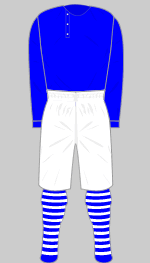
1873-1879 a i p
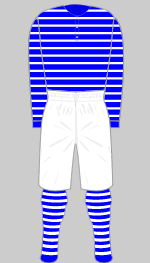
1879-1883 i p
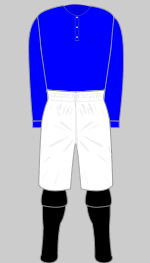
1883-1884 a p

1885-1886 v
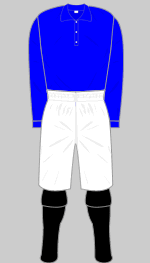
1888-1889 r
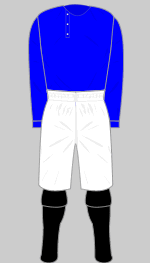
1893-1896 a l p r
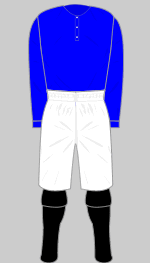
1896-1899 l p
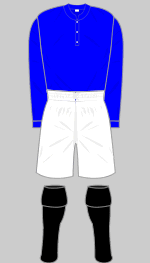
1899-1902 a p
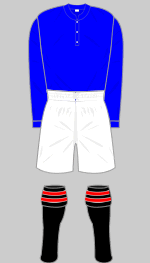
1902-1907 a c p r v
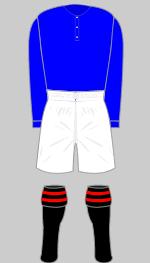
1907-1909 l p r
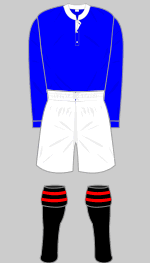
1909-1915 a c l p
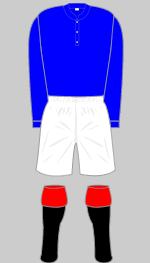
1915-1916 v
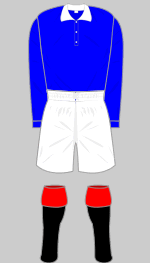
1916-1918 a p
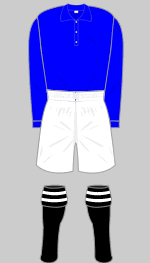
1918-1919 a p
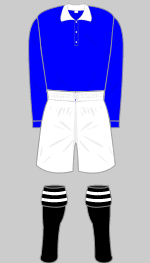
April 1919-1920 a p
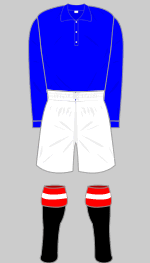
1920-1921 l p
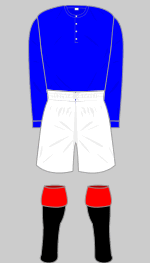
1921-1922 u
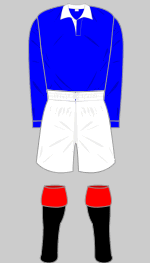
1922-1957 a d e l
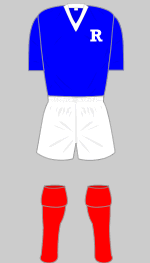
May 1956 v
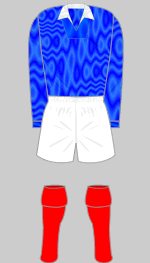
1956-1957 Eur v
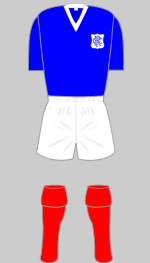
1956-1957 Eur v
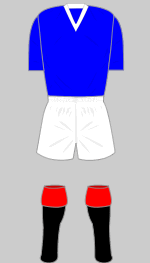
1956-1958 v
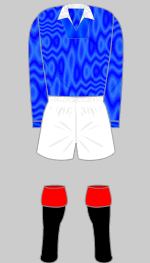
21 April 1958 v
1958-1959 v
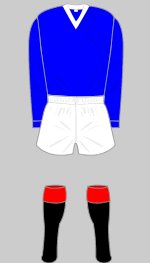
1959-1968 a d v

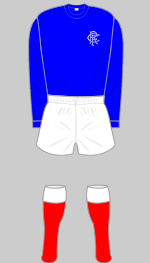
1968-1973 a d
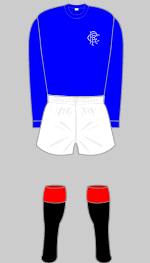
1973-1978 a d v
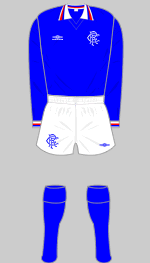
1978-1982 a g j

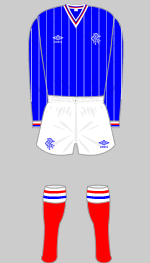
1982-1984 g j
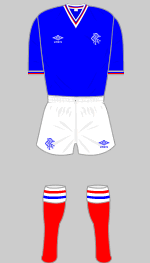
14 Sept 1983 w
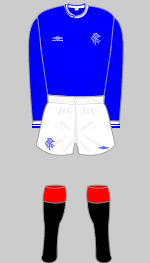
Aug-Sept 1984 v
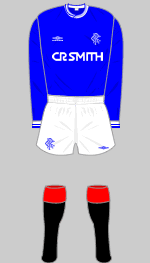
Sept 84-1986 g j
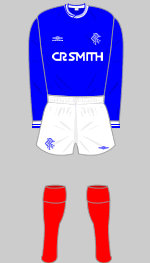
1986-1987 g j q
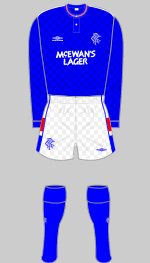
1987-1990 g k v
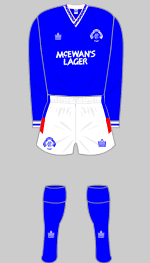
1990-1992 g v
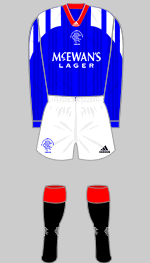
1992-1994 g h k v

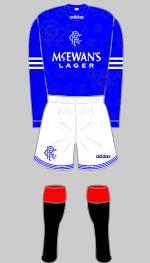
1994-1996 g v
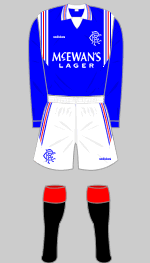
1996-1997 g v
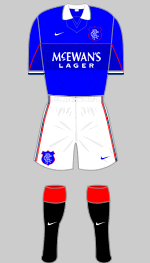
1997-1999 g v
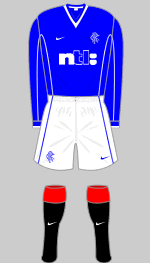
1999-2001 g v

2001-2002 g t
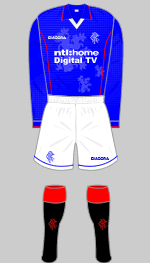
2002-2003 f v
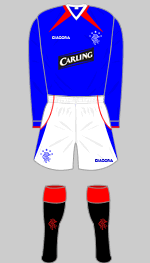
2003-2005 f g v
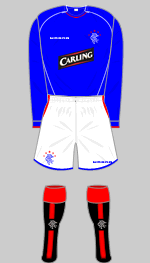
2005-2006 g v
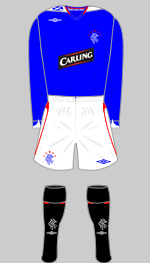
2006-2007 f v
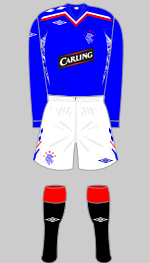
2007-2008 f
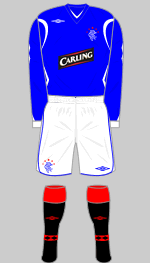
2008-2009 f v
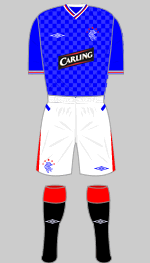
2009-2010 f v
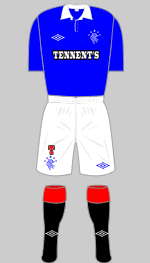
2010-2011 f
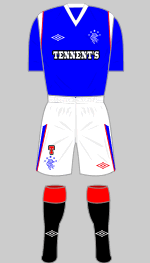
2011-2012 f
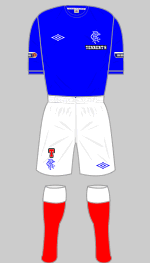
2012-2013 f
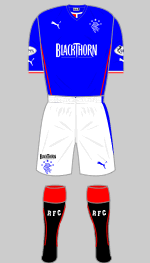
2013-2014 f v
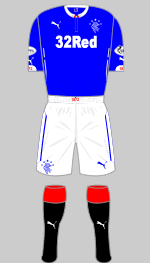
2014-2015 f
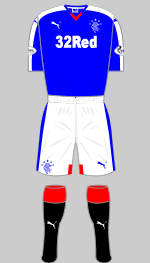
2015-2016 f
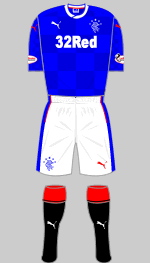
2016-2018 f
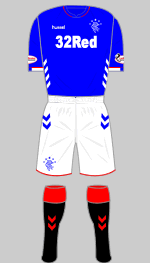
2018-2019 f
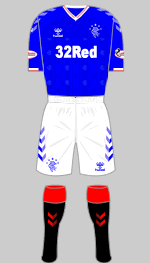
2019-2020 f
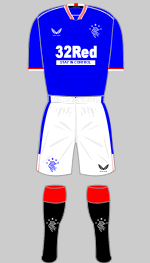
2020-2021 f
./.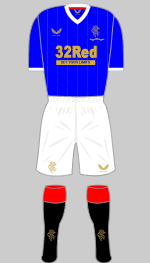
2021-2022 f
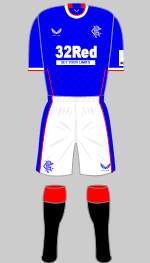
2022-2023 r
Background
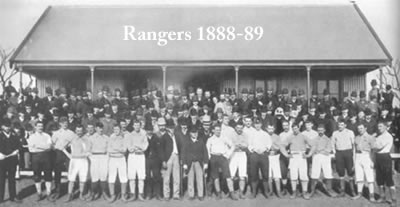 In 1872 Peter and Moses McNeill
agreed with their friends, Peter Campbell and William McBeath to form a team
that played two matches under the name of “Rangers” after
an English rugby club. In 1873 the club was formally constituted and
their first fixture list drawn up. The team were nicknamed “the Light
Blues” to distinguish them from the many Scottish teams that wore the commonplace navy jerseys of the time. The term was coined after the 1878 Scottish Cup final against Vale of Leven when journalists described the team as "the light and speedy blues." Later on, according to John Allan,
In 1872 Peter and Moses McNeill
agreed with their friends, Peter Campbell and William McBeath to form a team
that played two matches under the name of “Rangers” after
an English rugby club. In 1873 the club was formally constituted and
their first fixture list drawn up. The team were nicknamed “the Light
Blues” to distinguish them from the many Scottish teams that wore the commonplace navy jerseys of the time. The term was coined after the 1878 Scottish Cup final against Vale of Leven when journalists described the team as "the light and speedy blues." Later on, according to John Allan,
"When the late Mr. Angus Campbell was honorary secretary in 1879-80, jerseys with blue and white hoops were adopted. Matters had not been going too well with the team. Mr. Campbell felt his responsibility. He was a true Highlander with a liberal strain of superstition in his being. A change of colours might change the luck, so, at his suggestion, the old royal blue was packed away in the locker. Nobody was happy, however, until it was brought out again by a decree of a committee meeting of 1883. In royal blue the Rangers have played ever since."
The use of the term "royal blue" here is significant. The "Light Blues" nickname and the paleness of their shirts in photographs suggest a lighter shade was worn but I now believe this is due to the common use of film stock that was less sensitive to light at the blue end of the spectrum, so that their royal blue tops appear pale due to underexposure.
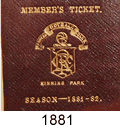
It is believed that the club's original crest, incorporating the letters "RFC" intertwined, was adopted from the club's formation but the first evidence of the design comes from the season ticket shown here. This never appeared on shirts.
Rangers reached the Scottish Cup final in 1877 and 1879 but on both occasions the village team of Vale of Leven got the better of them (Rangers refused to turn up for the replay in 1879 so Vale were awarded the cup). The first ever Old Firm game with Celtic took place in May 1888 (Celtic won 5-2). Two years later Rangers became founder members of the new Scottish Football League. At the end of the season Rangers and Dumbarton were level on points and a play-off was arranged to decide the championship. When this match was drawn, the title was shared.
In 1894, Rangers won the Scottish Cup for the first time, beating Celtic 3-1. They went on to win the trophy again in 1897 and 1898. In 1898-99 Rangers won all eighteen of their league matches to win the first of four consecutive championships. In December 1899, Rangers moved into the present Ibrox Park, designed by the ubiquitous Archibald Leitch. Three years later tragedy struck and 26 spectators died when a section of terracing collapsed during a Scotland v England international.
In 1903, Rangers won the Scottish Cup for the second time but, remarkably, they would not get their hands on this trophy for another 25 years. Success in the league was not so long in coming, with championships in 1911, 1912, 1913, and 1918.
Since 1904, Rangers have usually worn black and red socks, the colours of the Burgh of Govan where the club has always been based.
Between the wars, Rangers domination of the league was absolute. Under the management of William Struth they won 15 out of the 21 championships played up until the outbreak of World War Two as well as six Scottish Cups, winning the “double” for the first time in 1927-28. On 2nd January 1939, 118,567 fans crammed into Ibrox to watch Rangers beat Celtic 2-1 in the traditional New Year’s Old Firm derby – the highest attendance at a league match ever recorded in the British Isles.
In 1922 Rangers adopted white collars on their shirts to complement the black stockings with red tops seen the previous season. Remarkably, this outfit remained completely unchanged for almost 40 years.
After the Second World War, Rangers took up where they left off winning the first post-war championship and newly created Scottish League Cup and in 1948-49 they won the domestic treble. Rangers continued to dominate throughout the 1950s and early 1960s, amassing eight league titles, seven Scottish FA Cups and four League Cups.
In May 1956 Rangers embarked on a tour of Spain and in deference to the warm climate, adopted the new continental style of shirt. This was the first time the team had worn V neck tops. The large letter "R" on the shirts was not seen again. The unusual graphic used for this motif suggests these shirts may have been borrowed from a local team.
Rangers qualified for the European Cup for the first time in 1956-57 and played OGC Nice three times. They wore an iridescent top in two of these games and a new V neck jersey with crest in Nice.
In August 1956 Rangers wore V neck shirts for the first time in the league against East Fife. The old long-sleeved shirts with collars were retained for cold weather before the V neck shirt became standard in 1958-59.
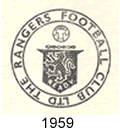 In 1959 the club crest was modified with a lion rampant appearing in the central shield
  above the club motto, "Ready." This was later updated to the modern version in use today. While this appears on official merchandise, literature as well as at Ibrox, it has never been worn on the team shirts. It was not until 1968 that a crest of any sort appeared on Rangers' shirts, the famous intertwined letters. This design has become synonymous with the club.
The
mid 1960s saw the pendulum swing in favour of Celtic and Rangers did
not win the league again until 1975.
 In 1971 during the traditional New Year’s Day Old Firm match a
second disaster occurred at Ibrox when barriers to the rear of passageway
13 collapsed. Sixty-six people lost their lives and more than 200 were
injured. As a result, the club set about a major redevelopment of Ibrox,
financed by the club’s enormously profitable football pool business.
In 1972 Rangers won their first –
and so far only – European honour, narrowly beating Moscow Dynamo
at the Nou Camp stadium. The occasion was marred by a pitch invasion
and clashes with the police which led to Rangers being banned from Europe
the following season.
In 1971 during the traditional New Year’s Day Old Firm match a
second disaster occurred at Ibrox when barriers to the rear of passageway
13 collapsed. Sixty-six people lost their lives and more than 200 were
injured. As a result, the club set about a major redevelopment of Ibrox,
financed by the club’s enormously profitable football pool business.
In 1972 Rangers won their first –
and so far only – European honour, narrowly beating Moscow Dynamo
at the Nou Camp stadium. The occasion was marred by a pitch invasion
and clashes with the police which led to Rangers being banned from Europe
the following season.
The 1980s were another comparatively bleak spell
for the ‘Gers as the “New Firm” of Aberdeen and Dundee
United emerged. Rangers' league form slumped and in 1986, the board
turned to Graham Souness, appointed as player manager, to turn the club’s
fortunes round. The combative Souness reversed the trend of the past
century by persuading top English players to move north and in his first
season he won the League and Cup double. He also, incidentally introduced plain red socks in place of the traditional black versions with a red  turnover. The revolution was completed
when Souness’ friend David Murray became the club’s new
owner in November 1988. Over the next ten years Murray oversaw the investment
of £90m on players and £52m on the stadium. The impact was
profound and between 1989 and 1997, Rangers won a record nine championships
in a row.
turnover. The revolution was completed
when Souness’ friend David Murray became the club’s new
owner in November 1988. Over the next ten years Murray oversaw the investment
of £90m on players and £52m on the stadium. The impact was
profound and between 1989 and 1997, Rangers won a record nine championships
in a row.
Between 1990 and 1994 a more elaborate version of the RFC crest was used before it was replaced by the simpler, 1968 style.
Since the millennium, Rangers and Celtic have more or less shared the honours but the big prize of a European trophy continues to elude both clubs.
 In recent years both Rangers and Celtic have
bowed to pressure distance themselves from their sectarian history and
clamp down on the behaviour of their fans. Rangers were originally identified
with the Presbyterian establishment while Celtic’s roots lay with
the impoverished Catholic Irish immigrants living in the city's east end. In nineteenth century Scotland
there was nothing unusual in this but the sectarian connections of most
clubs faded away over time. This was not the case for the Old Firm whose
rivalry was fuelled by the sharp divisions between the catholic and
protestant traditions which the West of Scotland shares with Ulster.
At its worst, the clubs became the focus of bigotry and hatred from
both communities and Old Firm matches were generally disfigured by the
singing of sectarian songs and violence. It was widely held that Rangers
would not sign Catholic players until Graham Souness publicly renounced
the club’s “unwritten policy” in 1989 when he signed
ex-Celtic player, Mo Johnston. In fact, around twenty Catholics
In recent years both Rangers and Celtic have
bowed to pressure distance themselves from their sectarian history and
clamp down on the behaviour of their fans. Rangers were originally identified
with the Presbyterian establishment while Celtic’s roots lay with
the impoverished Catholic Irish immigrants living in the city's east end. In nineteenth century Scotland
there was nothing unusual in this but the sectarian connections of most
clubs faded away over time. This was not the case for the Old Firm whose
rivalry was fuelled by the sharp divisions between the catholic and
protestant traditions which the West of Scotland shares with Ulster.
At its worst, the clubs became the focus of bigotry and hatred from
both communities and Old Firm matches were generally disfigured by the
singing of sectarian songs and violence. It was widely held that Rangers
would not sign Catholic players until Graham Souness publicly renounced
the club’s “unwritten policy” in 1989 when he signed
ex-Celtic player, Mo Johnston. In fact, around twenty Catholics 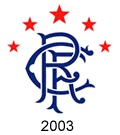 had
played for the club although none of these was prepared to acknowledge
their faith publicly.
had
played for the club although none of these was prepared to acknowledge
their faith publicly.
Rangers’ record is, quite literally, second to none. They are by some distance the most successful club in Scotland having amassed (by 2012) 54 League championships and 116 major trophies, both world records. They have won the domestic treble a record seven times and have competed in Europe more times than any other British club. Since 2003 the club's badge has featured five small stars - one for every ten championships.
After 23 years, Sir David Murray sold the club to businessman Craig Whyte for £1, an indication that rumours about the club's perilous financial position were true. In February HMRC took out a winding-up order over £14 million in unpaid taxes and the club went into administration, taking a ten-point penalty that handed the title to Celtic. Over the following weeks a stream of revelations emerged: HMRC were claiming an additional £75 million for tax-avoidance schemes operated by Murray and total debts amounted to £134m. The SFA handed Whyte a life time ban and a substantial fine for "not being a fit and proper person to be a director" while the club was hit with a £160,000 penalty and a 12-month transfer embargo. An investigation into illegal tax-avoidance continued with the threat of prosecution likely. As they were unable to file accounts, Rangers were not allowed to play in Europe the following season while the playing staff, who had taken substantial pay cuts in return for release clauses being inserted into their contracts, left en masse once the season ended.
Once it became clear that it would be impossible to negotiate a CVA with its creditors Rangers PLC was liquidated. A consortium led by Charles Green, bought the club's assets for £5.5m from the administrators in June 2012. As a result of the liquidation of the old club, Rangers membership of the SPL and SFA lapsed. Despite dire warnings about the financial consequences and a threatened boycott by supporters of other clubs, the SPL members voted overwhelmingly to refuse the "newco" Rangers admission on 13 July. The following Monday, under pressure from the SFA and SPL to admit Rangers to the second tier, the SFL members voted to accept the club into the Third Division.
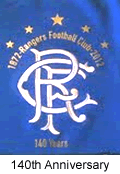 This debacle rocked Scottish football and reinvigorated calls for reform, shelved since the SFA commissioned McLeish Report of 2010. Rangers had at least survived and now had the opportunity to start again without crippling debt although the threat of sanctions imposed on the old club being imposed on the new one rumbled on. Opinion on the status of the "newco Rangers" was divided with many considering them to be a new entity. The club's management however insisted the club continued under a new limited company and was entitled to the old Rangers' historical record, a view endorsed by the SFA. However, they also argued that sanctions incurred for infractions of the previous regime should not be applied to the new one. To emphasise continuity, the team wore a special crest in the home game against Stirling Albion on 8 December 2012, which new research has established is the 140th anniversary of their formation. It is hard to escape the conclusion that the concept of continuity was being applied somewhat selectively.
As expected, Rangers won the Third Division title at a canter despite a transfer embargo imposed from the end of the 2012 summer transfer window. As associate members, Rangers did not have a vote when the SFL membership decided on a merger with the SPL in June 2013.
By 2014-15 Rangers were in the second tier but plagued by chronic financial problems, byzantine conflicts off the field and poor performances on it. Such was the toxic atmosphere surrounding the club that even the most loyal supporters stayed away in large numbers. After a bitter struggle, South African based businessman Dave King took control in March 2015 although he was unable to immediately take a seat on the board because his convictions for tax evasion in South Africa meant he would not pass the SFA's "fit & proper person" test. The season ended with Rangers losing heavily to Motherwell in the play-offs final over two legs, consigning them to another season in the Championship.
The following season Rangers won the Championship convincingly and reached the Scottish Cup final where they were beaten by Hibernian. Off the pitch, problems rumbled on between the new board and Mike Ashley, the chairman of Newcastle United who had taken 9% of Rangers' shares under a deal between Sports Direct under the previous Rangers regime. One of the many issues under dispute was Sports Direct's contract to market Rangers' merchandise under which the club received just 4% of the revenue. In May Rangers announced they were ripping up the contract. The new kits for the 2016-17 season were reported to have been ordered by Sports Direct without reference to the club and officials urged fans to boycott them. Ashley later sold his shares in the club and an "amicable" agreement was reached that provided the club with a fair share of revenue from sales. With large quantities of replicas unsold it was announced that the 2016-17 first choice strip would be retained and fans were now urged to buy them.
This was not the end of the saga, however. In June 2018, after Rangers signed a deal with Hummel and their retail partner, Elite Group, SDI Retail Servces, part of the Sports Direct group, were granted an interim injunction after claiming that they should have been given the opportunity to match some or all of the third-party offer to sell Rangers' merchandise. A year later the High Court ruled that Rangers were in breach of their agreement with Sports Direct by entering into the agreement with Hummel and Elite Group. As a result the club had to pay £450,000 in costs to SDI and were placed under an injunction banning them from wearing or selling Hummel merchandise in 2020-21. Hummel and Elite Group rescinded their agreement with Rangers in February 2020 who then launched legal action to recover £2.8 million they claimed was owed to them from 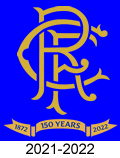 the sale of merchandise. Castore, a new company incorporated in March 2020, was awarded the contract to supply Rangers kit for the 2020-21 season.
After years of turmoil on and off the pitch, Rangers fortunes finally took a turn for the better in 2020-21. As Celtic fell apart, Rangers clinched the Premiership title on 7th March with six games to go. A 4-0 victory over Aberdeen on the last day of the season sealed an undefeated league season and over 100 points, 25 points ahead of their Glasgow rivals.
The following season marked the club's 150th anniversary. Although they fell short in the Premiership, finishing as runners-up, four points behind Celtic, they won the Scottish Cup and enjoyed an epic run in Europe, reaching the final of the Europa League where they were beaten by Eintracht Frankfurt on penalties.
Sources
Rangers Away Kits- (a) Alick Milne
- (b) The Glasgow Story
- (c) Dundee FC - Images of Sport (Paul Lunney 2001)
- (d) London Hearts
- (e) Aberdeen FC Images of Sport (Paul Lunney 2000)
- (f) Rangers Official Site
- (g) empics
- (h) Airdrieonians FC - Images of Sport (Brian Bollen 2002)
- (i) The Story of The Rangers - Fifty Years' Football 1873-1923 (John Allan)
- (j) Stephen Alford
- (k) Christoher Worrall
- (l) Rangers History Project - this independent site, set up in June 2007, has an fine collection of old team photographs.
- (m) SNS Pix
- (n) jumpers4goalposts
- (o) Alexander Perkin
- (p) Sandy Jardine, David Mason (Rangers' Historian) & The Scottish Football Museum
- (q) William Walker
- (r) MySpace
- (s) Duncan Blackwell
- (t) Scott Boyce
- (u) Keith Ellis
- (v) Ian McConnel
- (w) Wlliam Kay
Crest information sourced from Rangers.co.uk. Crests are the property of Rangers FC.