


Chesterfield
Formed 1867
Elected to Division Two 1899. Failed re-election 1908.
Founder member of Division Three (North) 1921. Relegated to the National League 2018.
Kit History
Chesterfield
1867-1881
Club wound up
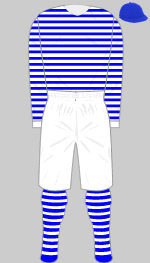
1870-1876 t
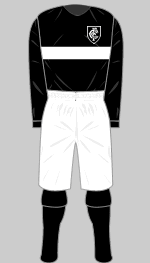
1879-1880 t
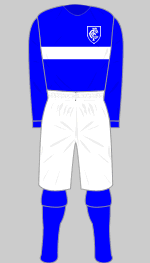
1880-1881 t
Chesterfield Town
1884-1915
Club wound up
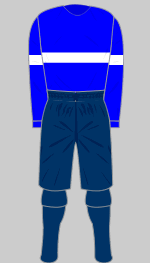
1884-1885 a q
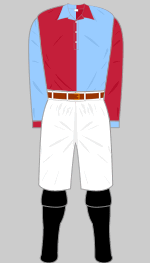
1885 a
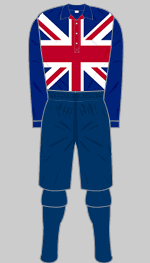
1892-1893 a
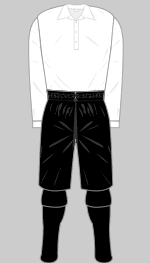
1894-1898 a
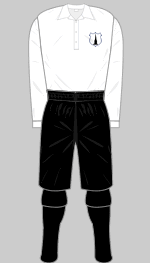
1898 a
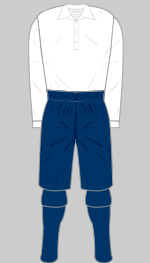
1899-1902 a n q
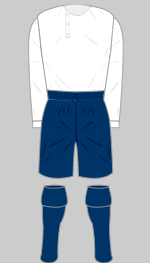
1902-1903 n
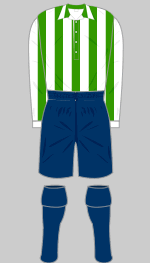
1903-1905 r u
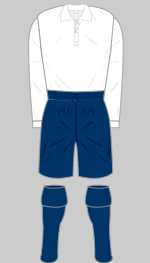
1905-1906 n v
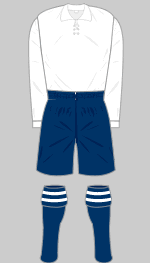
1906-1907 a i n
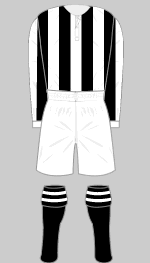
1907-1908 a h n
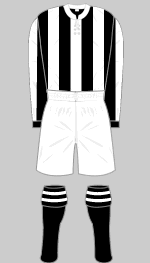
1909-1910 n
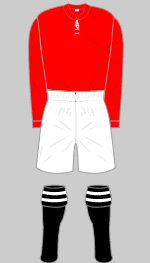
1910-1911 a
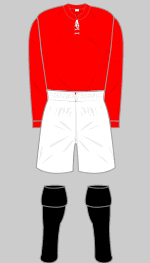
1911-1915 a
Chesterfield
1915-1917
Club disbanded by order of the FA
1915-1917 a
Chesterfield Municipal
1919-1920
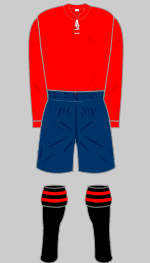
1919-1920 a
Chesterfield
1920
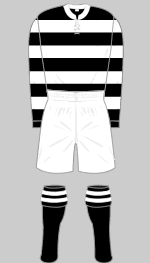
1920-1921 a
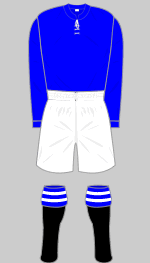
1921-1928 a
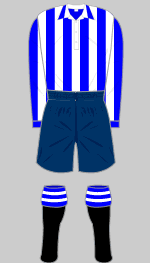
1928-1930 a b
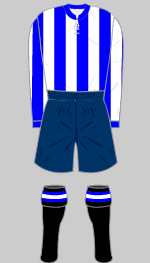
1930-1931 p q
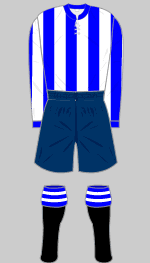
1932-1935 a l n
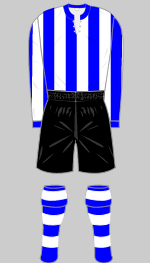
1935-1937 a n
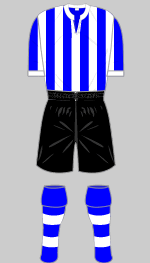
1937-1938 n
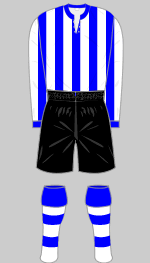
1938-1944 a l n q
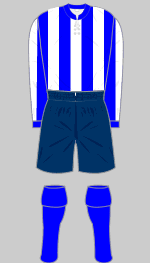
1944-1945 a
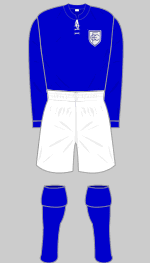
1945-1946 a n
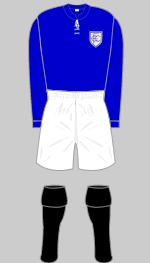
1946-1947 a n
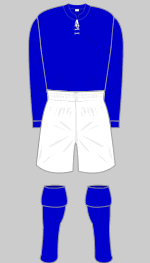
1947-1948 n
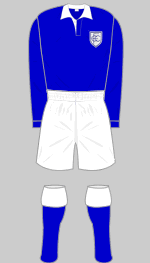
1948-1950 a n
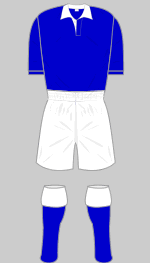
1950-1951 n
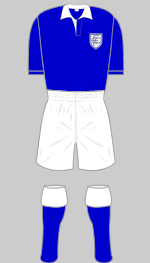
1951-1958 a n
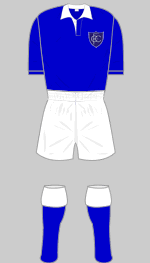
1958-1959 n
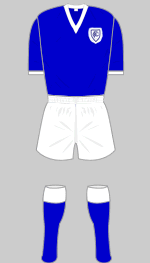
1959-1962 a m n p
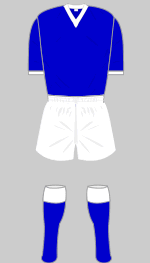
1962-1964 a n
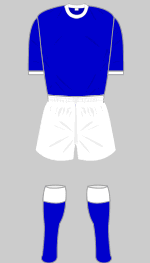
1965-1966 n
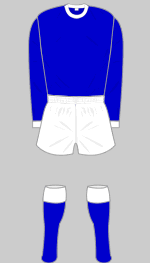
1966-1968 a n
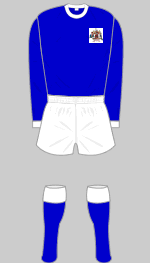
1968-1970 a n
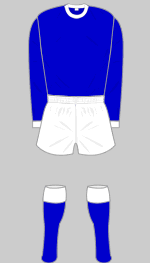
1970-1972 a d
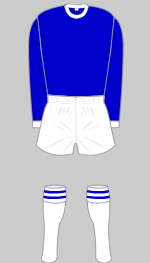
1972-1973 a n o
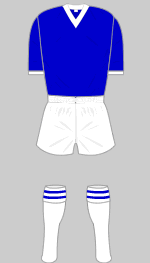
1 Oct 1972 n o
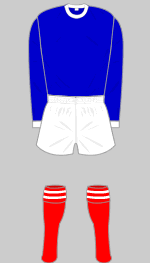
1972-1973 alt n o
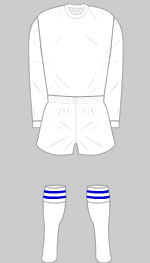
1972-1973 alt n
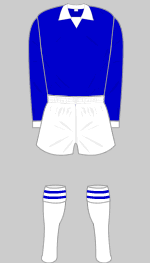
1973-1975 a n
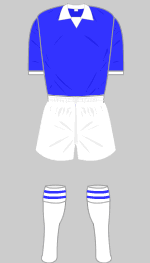
1975-1976 n
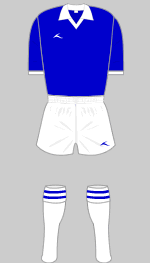
1976-1978 a k
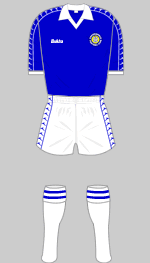
1978-1979 a k

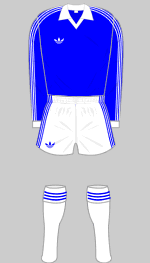
1979-1980 a k
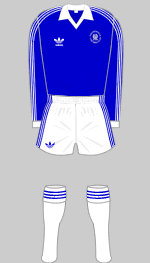
1980-1982 a
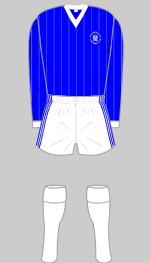
1982-1983 a
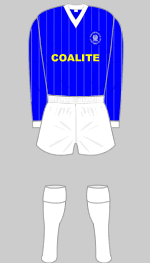
1983-1984 a
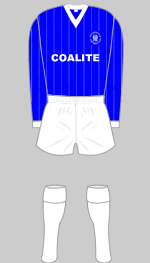
1984-1985 a
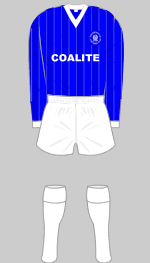
1985-1986 a e
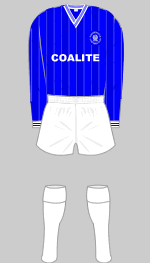
1986-1987 a
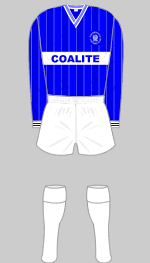
1987-1988 a o
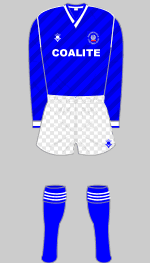
1988-1989 a n
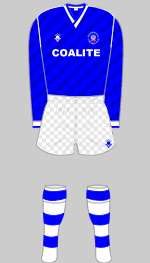
1989-1990 a j n
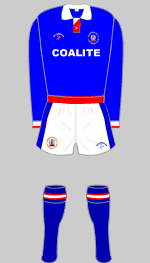
1990-1992 a f j n
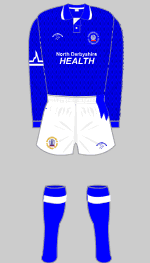
1992-1994 a j
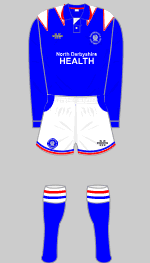
1994-1996 a g
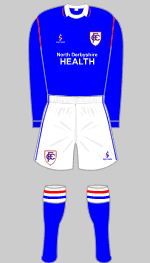
1996-1998 a g n
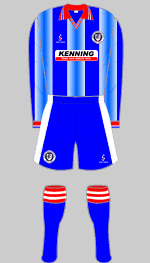
1998-2000 a g j
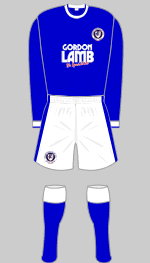
2000-2001 a g
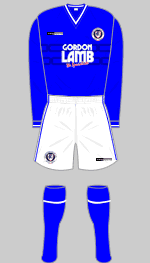
2001-2002 a g
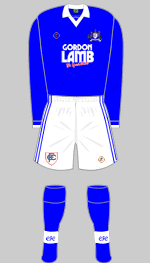
2002-2003 a g n
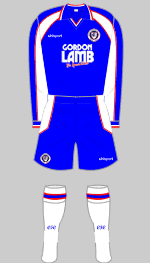
2003-2004 a g j
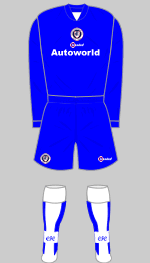
2004-2005 a n
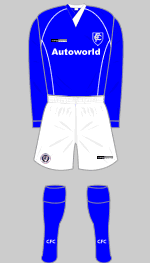
2005-2006 a
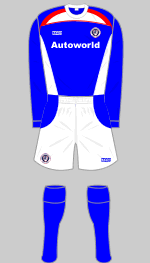
2006-2007 a n
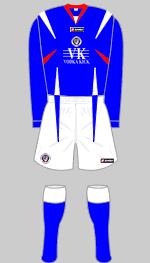
2007-2008 a
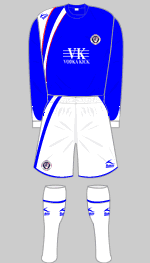
2008-2009 m
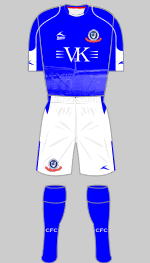
2009-2010 a
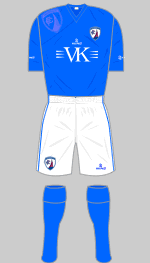
2010-2011 a
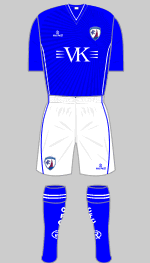
2011-2012 b
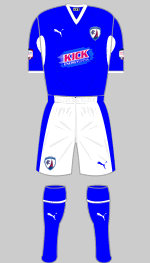
2012-2013 a
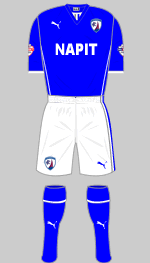
2013-2014 a
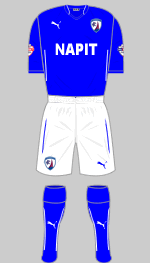
2014-2015 a
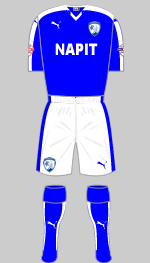
2015-2016 a
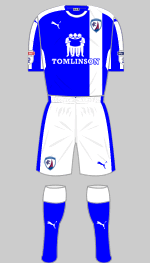
2016-2017 a
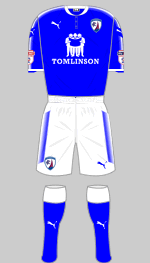
2017-2018 a
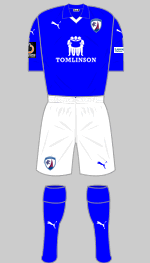
2018-2019 a
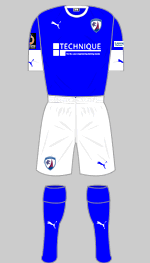
2019-2020 a
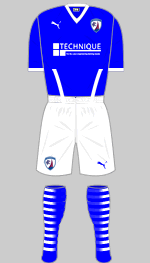
2020-2021 a
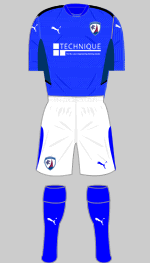
2021-2022 a
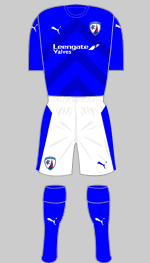
2022-2023 a

2023-2024 a

2024-2025 a
Background
 Although there are claims that
Chesterfield were formed in 1866, the club historian has cast doubt on this,
citing October 1867 as the date on which the first Chesterfield football club was founded. There is another view, supported by an excellent article in the club's comprehensive history section by Stuart Basson that the modern club was in fact formed as late as 1919. Stuart has convincingly argued that the current club is in fact the fourth to have carried the name.
Although there are claims that
Chesterfield were formed in 1866, the club historian has cast doubt on this,
citing October 1867 as the date on which the first Chesterfield football club was founded. There is another view, supported by an excellent article in the club's comprehensive history section by Stuart Basson that the modern club was in fact formed as late as 1919. Stuart has convincingly argued that the current club is in fact the fourth to have carried the name.
The original Chesterfield's first match appears to have been against Garrick FC from Sheffield although the score is lost. The first reference to the club’s colours comes in the 1870-71 season when they are described as “blue shirts and caps with white trousers.”
Chesterfield is renowned for the famous crooked spire of St Mary’s and All Saints Parish Church and so the team is known to this day as “The Spireites.” In September 1881, the original club got into financial difficulties and was wound up.
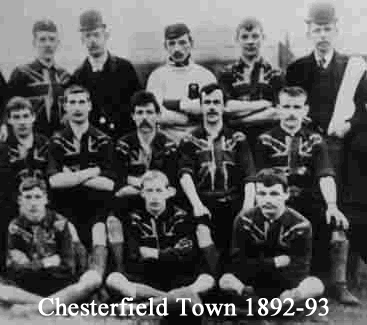
In 1884 former members of the old team and a group of players from Spital FC formed a new club known as Chesterfield
Town. They grew to local prominence, joining the Sheffield League in 1891
and winning it at the first attempt. It was during this period that the
club turned out in shirts featuring the union flag, one of the 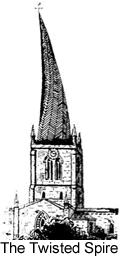 most unusual
playing kits of the era. John Taylor believes that the shirts were found in the loft of the Spital Hotel and, rather than throw them out, the landlord donated them to the club. We now know that the shirts were originally worn by Spital United and probably ended up in the hotel when that club closed down.
most unusual
playing kits of the era. John Taylor believes that the shirts were found in the loft of the Spital Hotel and, rather than throw them out, the landlord donated them to the club. We now know that the shirts were originally worn by Spital United and probably ended up in the hotel when that club closed down.
In 1897, Chesterfield Town stepped up to the Midland League finishing fourth, third and fourth. For the 1898-99 season the club was presented with a set of silk badges bearing the famous crooked spire. At the end of that season Chesterfield successfully applied for admission to the Football League and became a limited company. They stayed in the Football League Division Two until 1908 when they were voted out having applied for re-election for the fourth season in a row.
The club returned to the Midland League where they enjoyed some success prior to the First World War but in 1915, faced with mounting financial problems, the club was wound up. A new Chesterfield FC was immediately formed by a local restaurateur, CW Everest, and this team competed in the Midland Combination with several "guest players" from Football League clubs. This club was disbanded in 1917 following a scandal over payments to players, following which 40 players and officials were suspended. (Clubs were not permitted to pay their players during the Great War). Shortly afterwards, the local council formed a sports committee, which resolved to form a new association football club that would be directly accountable to the electorate.
On April 24th, 1919, Chesterfield Municipal FC was formed but their start to the new season was far from auspicious, as they were thrown out of the FA Cup for fielding an ineligible player. In 1920, the club won the Midland League championship and under pressure from the FA, cut their ties with the council and became Chesterfield FC - the fourth club to have borne this name - and were chosen to join the new Northern Section of the Third Division of the Football League. The familiar blue shirts and white shorts were worn for the first time in that first league season although these were replaced by striped shirts in 1928.
In 1931 Chesterfield won their divisional championship and returned to the Second Division after an absence of 23 years but they lasted only two seasons before relegation. In 1936, however, they won promotion for the second time and by the time war broke out they had established themselves firmly in Division Two.
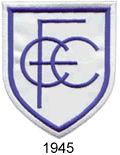 Immediately after the Second World War the familiar blue shirts and white shorts were reintroduced. It is possible that the old striped shirts were unobtainable at the time because of clothing rationing. Shortages notwithstanding, a crest consisting of the letters, "CFC" on a white shield was sewn onto the players' shirts. Variations in the way the letters are intertwined is a subject that has vexed diehard supporters (not least our Research Associate) to this day.
Short sleeves were adopted in 1950 although the number 10 shirt, worn by George Smith, always had long sleeves because Smith had a withered arm. In 1951 Chesterfield were 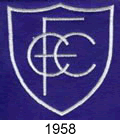 relegated back
into Division Three (North).
relegated back
into Division Three (North).
For the 1958-59 season the crest was modified: the colours were reversed and the shield now had a curved top, coming to a point at the centre. The following season (1959-60), modern shirts in the "continental style" were adopted, with V necks and short sleeves. 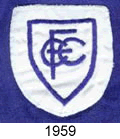 These were made by Humphrey Brothers of Stockport, otherwise known as Umbro, who supplied Chesterfield's shirts until the mid Seventies. The crest was altered once again and was embroidered poorly, appearing slightly asymmetrical. John Taylor observes that the crest on the red change shirts was much smarter with the white edging following the line of the shield.
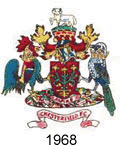 Chesterfield followed the trend by adopting crew neck shirts and dropping the traditional crest in the Sixties but in 1968 the borough council asked the club to adopt their new coat of arms. Printed in five colours, the original design was too large to fit on the shirts so a second version was hastily created. The result, worn on a white patch, was poorly drawn and off-centre and it was dropped in 1970.
Chesterfield dropped into the Fourth
Division and endured lean times during the 1960s, narrowly avoiding having
to seek re-election on two occasions. In 1970 things began to look up
and Chesterfield won the Fourth Division title. The adoption of white socks with blue cadet stripes in 1972 was considered a radical departure for this most conservative of clubs. In the 1972-73 season the club 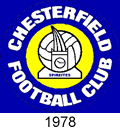 wore V neck shirts with short sleeves on a very hot day in October against Rotherham United and later wore red socks in two home games when Bolton and Port Vale turned up with white stockings. An all white strip was also used in five home games but proved unpopular with supporters and was quietly retired.
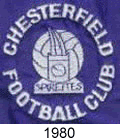 In 1978-79, a new club crest was introduced and worn on the classic, Bukta trimmed shirts. The crest, which featured the famous crooked spire, had first appeared in the Sixties as a lapel badge worn by supporters.
The club bobbed along in the Third Division and even won the Anglo-Scottish tournament in 1981. Although this was a rather meaningless competition, 14,000 fans packed into Saltergate to watch the quarter-final with Glasgow Rangers.
Relegation in 1983 was followed by yet another Fourth Division title
two years later. The crest remained basically unchanged until 1996 but between 1988 and 1994 the base of the spire was red with "Spireites" 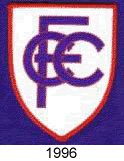 printed in white, Red appeared as a third colour on the team strips for much of this period.
In the early 1990s the club was back in the Fourth Division
and faced mounting financial and boardroom problems but their fortunes
revived in 1995 when they won the play-offs to earn promotion to the new
Second Division, beating arch-rivals Mansfield Town along the way. In 1996 the old 1945 crest was revived. That season the team enjoyed a remarkable run in the FA Cup where they
took Middlesbrough to a replay after surrendering a 2-0 lead in the first
match. A special badge was created for these games that placed the CFC monogram inside a circle with the legend "Chesterfield FC Est. 1866" 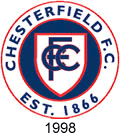 and the legend "1997 FA Cup Semi-Final" in script embroidered below. This badge was adopted the following season on the team's away kits and in 1998, it appeared on the team's new home kit where, with the exception of two seasons, it has remained.
In 1999 the club was relegated yet again but in 2000-01, seemed
on course to win the Nationwide Third Division championship. In February,
however, the FA announced an investigation into the affairs of club chairman
Darren Brown, which resulted in a fine of £20,000 and nine points
being deducted. Brown resigned and although they were 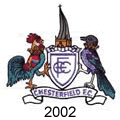 deprived of the
championship, the Spireites still achieved automatic promotion.
deprived of the
championship, the Spireites still achieved automatic promotion.
After Brown’s departure, the extent of the club’s huge debts was uncovered and the club was only rescued from extinction by the formation of the Chesterfield Football Supporters Society (CFSS), which raised £30,000 in subscriptions, and took over control. The 2002-03 strip was designed by the CFSS Heritage Group and included a new crest, designed by John Taylor, now an HFK Research Associate. The design combined the traditional CFC emblem with the cockerel and magpie from the town's coat of arms.
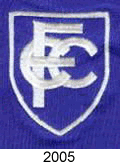 The 2004-05 shirts were chosen by the club's supporters in an on-line poll although non-traditional blue shorts were retained. White shorts were often worn away from home along with alternate shirts sponsorship by Vodka Kick in this and the previous season. The following season (2005-06), white shorts were restored with a curious bat-like motif on the back. Several players found this so embarrassing that they untucked their shirts to cover it up. The circular badge was replaced for this season with yet another version of the CFC crest.
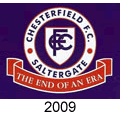 The 2009-10 season marked the team's last at Saltergate. A successful share issue by CFSS raised sufficient capital for work to begin on a new stadium on Whittington Moor. To mark this occasion the team played in specially designed shirts with a jacquard image of Saltergate woven into the fabric as well as a commemorative crest with "End of an Era" embroidered onto a red scroll below
  the usual circular badge.
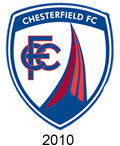
In 2010 the club moved into their new 10,000 seat b2net stadium and to celebrate a brand new crest was designed. This incorporated the famous interlocked letters along with a semi-abstract drawing of the crooked spire, therefore uniting two historic motifs. The new look and surroundings seem to do the trick as Chesterfield finished the 2010-11 season as champions of League Two and set their sights on the Championship. The financial burden of their new stadium led the shareholders to cede majority ownership to Dave Allen, a casino owner from Sheffield. After initially 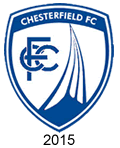 investing £4m, Allen later had to lend the club a further £6m to keep it afloat. Following relegation to League Two in 2016, matters came to a head when Allen asked his fellow board members to set aside repayments on their own loans and forgo interest. There was no agreement and Allen walked out. Shortly afterwards the rest of the board resigned. Forced to sell players and without leadership from the top, Chesterfield were relegated to the National League having finished bottom of League Two in 2018.
In 2015 the badge was altered slightly with the removal of the red accent colour. The previous version was reinstated in 2016.
With grateful thanks to HFK Research Associate, John Taylor, who supplied the artwork for the crests and considerable detail to enhance this narrative.
Sources
- (a) Chesterfield FC Official Website includes some rare photographs and a detailed history of the club’s kits and is well worth a visit
- (b) Chesterfield Rivals Website
- (c) Doncaster Rovers FC - Images of Sport (Peter Tuffrey)
- (d) Football Cards
- (e) Bristol Rovers FC - Images of Sport (Mike Jay)
- (f) Scarborough FC - Images of Sport (Paul Eade 2002)
- (g) empics
- (h) The Mighty Mighty Whites
- (i) Association of Football Statisticians - provided by Pete Wyatt
- (j) David King
- (k) Alick Milne
- (l) Simon Monks
- (m) Football Shirt Culture
- (n) John Taylor - John designed the 2002-03 kit and the badge worn that season. (HFK Research Associate)
- (o) Cobcon
- (p) Keith Ellis
- (q) cfchistory.com
- (r) Athletic News (18 January 1904) submitted by Kingsley (Wrexham AFC)
- (s) 80tribalcolours
- (t) Charles Alcock's Football Annuals 1869-1891 researched by Robin Horton
- (u) Athletic News (18 January 1904, 7 August 1905) submitted by Richard Essen
- (v) Illustrated Sporting & Dramatic News (28 October 1905) submitted by Richard Essen
Crests are the property of John Taylor and/or Chesterfield FC.