

Queen's
Park
Formed 1867
Elected to Scottish Division One 1900
Kit History
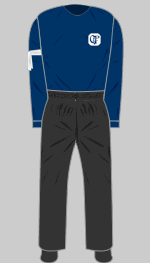
1868-1870 k
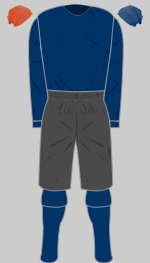
1870-1872 k m
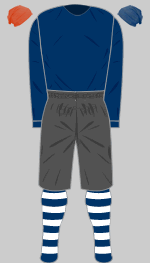
1872-March 1873 k m
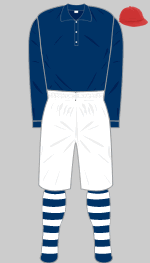
April 1873 a b k
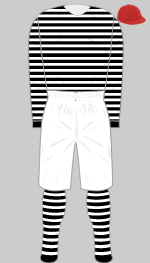
October 1873 a b k
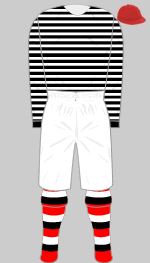
1874-1876 k
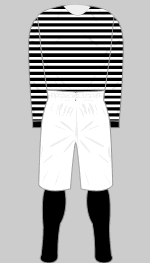
1876-1881 a
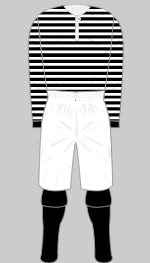
1888-1890 a
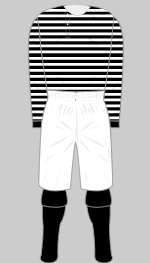
1893-1894 a
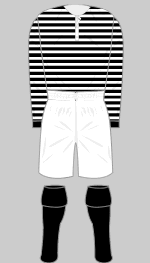
1899-1905 a
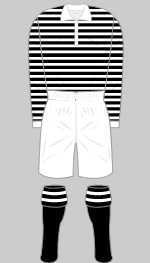
1907-1908 c
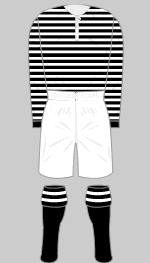
1910-1927 a
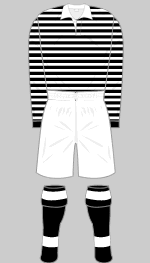
1927-1928 a j
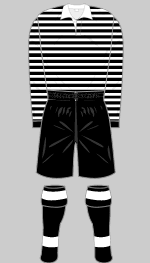
1927-1928 away
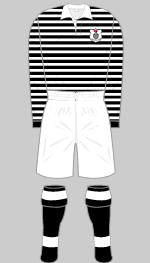
1928-1929 a

1928-1929 away
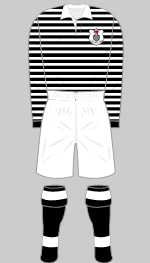
1929-1931 a
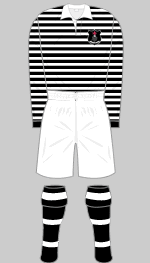
1931-1933 a
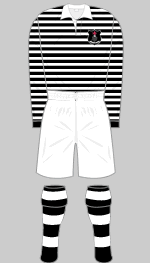
1933-1935 a
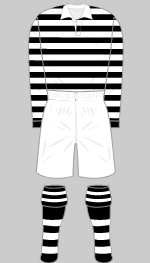
1935-1936 d
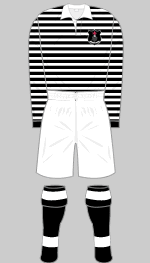
1936-1940 a
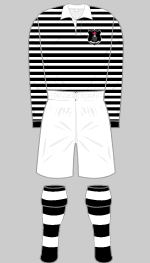
1940-1946 a
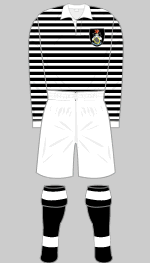
1948-1953 a j
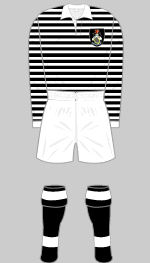
1955-1957 a
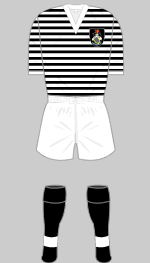
1957-1958 1 l
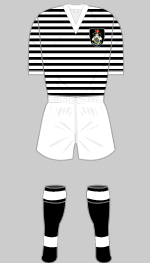
1957-1960 a
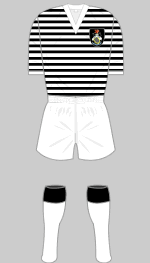
1960-1962 a
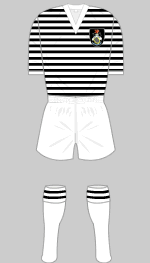
1962-1963 a
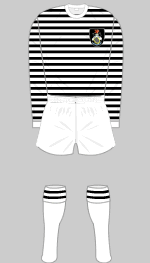
1965-1972 a
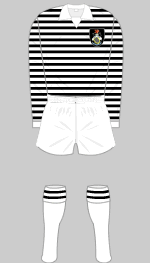
1972-1977 a e
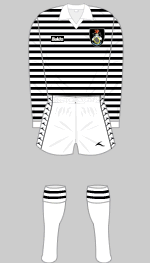
1977-1981 a
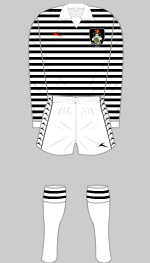
1981-1983 i l
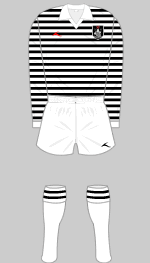
1983-1988 e f h i
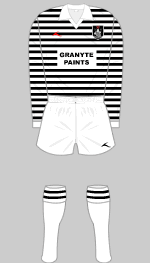
1988-1989 i
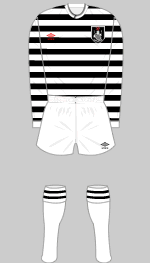
1989-1992 e i
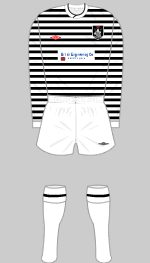
1992-1994 e i
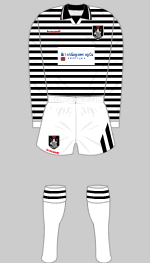
1994-1995 i
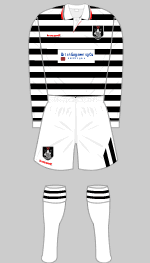
1995-1997 e g i
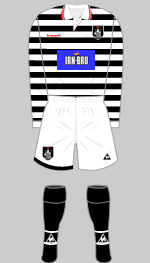
1997-1998 i
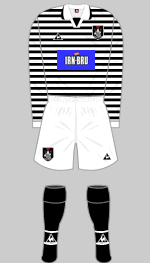
1998-2001 e
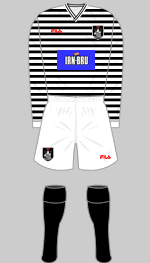
2001-2004 e
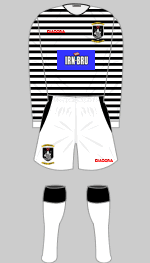
2003-2006 e
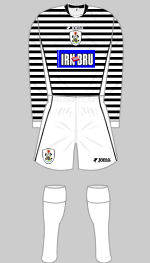
2006-2008 e
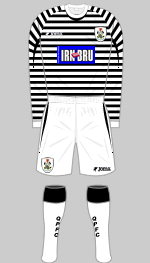
2008-2011 b
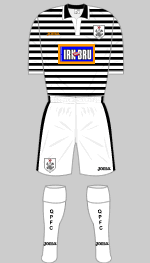
2011-2013 b
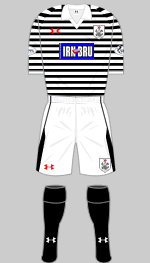
2013-Aug 2016 b
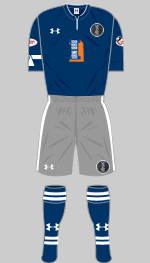
Aug 2016-2018 b
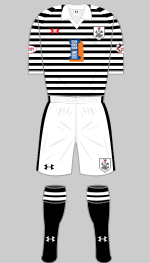
2018-2020 b
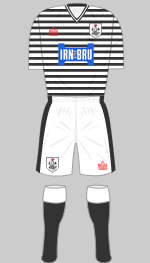
2020-2022 c
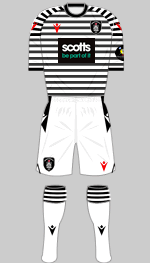
2022-2023 c
Background
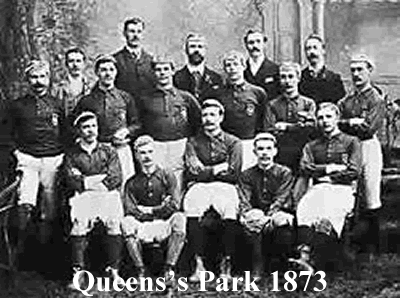 Formed on 9 July, 1867, Queen’s Park are not merely Scotland’s
oldest club: they are an institution that did more to influence the
way the game developed in the British Isles than any other club. Although they drew their membership from the prosperous upper and middle classes, by
playing exhibition games throughout central Scotland they inspired working
class men to take up the game. A tour of Ireland
in 1879 led to the formation of Cliftonville FC, the first Irish football
club and the creation of the Irish FA. Queen’s Park played under
their own rules until the mid-1870s, when they adopted the English FA
rules.
Formed on 9 July, 1867, Queen’s Park are not merely Scotland’s
oldest club: they are an institution that did more to influence the
way the game developed in the British Isles than any other club. Although they drew their membership from the prosperous upper and middle classes, by
playing exhibition games throughout central Scotland they inspired working
class men to take up the game. A tour of Ireland
in 1879 led to the formation of Cliftonville FC, the first Irish football
club and the creation of the Irish FA. Queen’s Park played under
their own rules until the mid-1870s, when they adopted the English FA
rules.
Early “kick and rush” tactics consisted of a forward dribbling the ball up field supported by his teammates, rather like a rolling maul in rugby. Queen’s Park’s revolutionary passing game and team play proved vastly superior and are the foundation of modern tactics. The club also introduced new ideas such as cross bars, the half-time break and free kicks.
As soon as the club was formed a small sub-committee was charged with procuring "such badges etc that each member be supplied with two of different colours...with the object of the player wearing the particular colour of the side he was on." Alas details of the colours and badges involved are lost so our graphic can only suggest what the players might have worn. It is, however, known that most (but not all) of the players sported blue guernseys. On 7 July 1870 the club's rules were amended and now included a proviso that no member could take part in a match unless in the official uniform of guernsey and cowl, which was to be reversable (red or blue). Two years later blue and white striped stockings became part of the uniform. The first official international match between England and Scotland took place on November 30 1872 in Glasgow. All eleven Scottish players came from Queen’s Park who turned out in their club kit. Navy and white are the national team’s first choice colours to this day.
Queen’s Park regularly competed in the English FA Cup from its inception in 1872, reaching the final in 1884 and 1885. In 1873 Queen’s Park became founder members of the Scottish FA and entered the inaugural Scottish Cup.
On 9 April 1873 the club rules were altered to define the full uniform for the first time: red cap, blue jersey and white knickers. This apparently did not meet with general approval and during the close-season members were canvassed over changing it. On 26 September Mr D Wotherspoon moved that the new kit be "red cap, black and white inch stripe jersey and stockings and white knickerbockers." The new outfit was worn in Queen's Park's first ever Scottish Cup match, played on 25 October 1873 against Dumbreck FC, a match that also marked the opening of their new home at Hampden Park. This style of jersey became a popular design, widely available in Scotland but only Queen’s Park have worn these narrow hoops consistently for over 130 years, giving rise to their nickname “The Spiders” (the narrow stripes supposedly resemble a spider’s web).
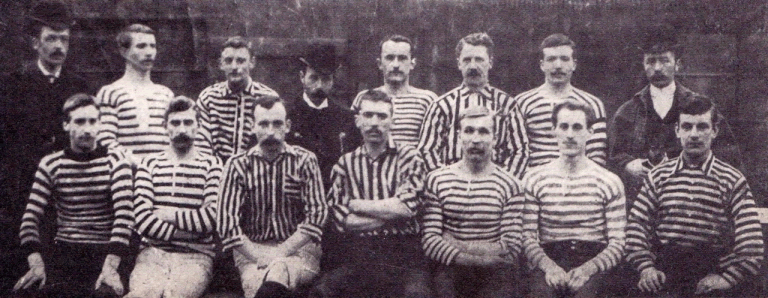 The club rule book specified that the players' jerseys should have 32 one-inch black hoops on a white background but in practice members turned out in a variety of tops with vertical as well as horizontal stripes, a range of collars and dark knickers as well as white. Even after professionalism was recognised in Scotland in 1893, Queen's Park continued to insist that players buy their own kit on the basis that were the club to provide kit it would amount to an inducement or form of recompense incompatible with amateur principles. It was not until 1911 that they relented and provided the players with their kit.
Up until 1876 each player wore distinctive socks (apart from TC Highet, who wore a black and white cap and no socks) and the club issued cards to spectators giving the teams and the colours of each player's stockings. This practice was adopted in international matches as well.
The club’s dominance of the early game was underlined by their performance in the Scottish FA Cup: they won the trophy three times in a row twice – 1874-1876 and 1880-1882 with further wins in 1884, 1886, 1890 and 1893. Only Celtic and Rangers have won the trophy more often.
By the mid-1880s, Queen’s Park regularly drew 10,000 spectators for friendly matches and they left their original Hampden Park ground (the UK’s first enclosed football stadium with turnstiles) for a new purpose-built stadium near Crosshill in 1884. The Hampden Park name was retained. (This ground was later sold to Third Lanark and renamed Cathkin Park).
When the Scottish Football League was formed in 1890, Queen’s Park declined an invitation to join. The committee running the club were firmly committed to the principles of amateurism enshrined in the club’s motto, Ludere Causo Ludendi ("to play for the sake of playing"). Their view was that a league structure would inevitably lead to professionalism and they would have nothing to do with it. This prediction became reality in 1893 when professionalism was finally recognised in Scotland and the Scottish League was expanded with the creation of a Second Division. Queen’s Park found it harder to arrange fixtures with leading clubs whose increasing league commitments took precedence. In 1900 the committee reconsidered their position and applied for membership of the Scottish Football League and were elected directly into the First Division. Queen’s Park met Celtic in the final of the Scottish Cup that year, losing a thrilling match by 3-4. Despite their belated elevation to the Scottish League, Queen’s Park were finally eclipsed by the professional clubs.
Nevertheless, ambitious plans were laid for an enormous stadium. Twelve acres of farmland at Mount Florida were bought and the third Hampden Park was opened in 1903. With a capacity of 150,000, this was the largest football stadium in the world until 1950 when the Maracana was built in Brazil. Hampden became the home of the Scottish national side and one of the most famous and intimidating venues in the world.
The club struggled to compete against their professional counterparts and generally finished near the foot of the table. They were spared relegation in 1906, 1911, 1912, 1913 and 1915 when they successfully applied for re-election to the First Division. In 1910 they were given special dispensation to prevent players being poached by the professional clubs during the season (a regulation that is still in force).
When the Second Division was belatedly reinstated in 1920 with the
incorporation of the Central League, the old election procedures were
replaced by automatic promotion and relegation. Queen’s Park could
no longer rely on the cosy support of the First Division clubs and in
1922 they were relegated. This proved a temporary setback as the Spiders
stormed to the Second Division title the following season and remained
 in the First Division until 1940 when the Scottish League was suspended.
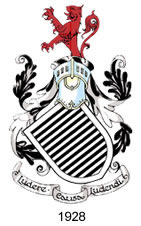
Since 1928 the club's crest has been worn on players' shirts. Although the background shield has changed over time, the crest itself has remained unchanged.
In 1945 Queen’s Park were placed in Division “A” (the top level in the restructured league) but they were relegated in 1948. After eight seasons in the Second Division, “The Hoops” returned to the top division as champions in 1956 but they could no longer compete against the professional First Division sides and went down again in 1958. As an amateur club, Queen’s Park were unable to retain a successful side because the professional clubs would snap up their players once the seasonal embargo expired at the end of April.
When the Premier Division was created in 1975, Queen’s Park were placed in the new Second Division (third tier). They were promoted in 1981 but held on for only two seasons before they were relegated. In 1995 the Scottish League was restructured into four divisions of ten clubs: Queen’s Park found themselves in the basement, the new Third Division. In an effort to become more competitive, the club amended their rules so that former professional players could now play for the team.
By the early 1990s Hampden Park was a crumbling ruin with vastly reduced capacity, no longer fit to be considered the national stadium and venue for showcase matches. Work began in 1992 to rebuild the north and east stands. In 1996 an ambitious second phase was initiated to redevelop the south and west stands. After £70m had been spent, (mostly from public funds) the new Hampden Park was opened in May 1999 as a multi-purpose stadium with FIFA and UEFA five star rating and an all-seat capacity of 52,000. Queen’s Park FC continue to own the stadium and have the right to play 1st XI fixtures there but have leased Hampden for 20 years to the Scottish FA.
The Spiders won promotion to League Two at the end of the 2016-17 season, beating Clyde in the play-off finals.
In preparation for their 150th anniversary, the club adopted a modern version of their original navy tops with grey shorts. The white trim on the right sleeve represents the ribbon worn in the very earliest days to distinguish one team from another. It was planned that this revived outfit would be worn for two seasons. The season did not end well and they were relegated after losing out in the end of season play-offs.
A landmark decision was taken in 2019 that would change the course of the club's long history. Due to their amateur status Queen's Park could not collect transfer fees when their best players signed for other, professional teams. The issue was put to the membership in November 2019 and 91% voted in favour of turning professional, enabling the club to sign players on longer term contracts and charge transfer fees.
The SFA's lease on Hampden Park was due to expire in 2020. Playing in such a prestigous setting may have earned the club kudos but the incongruity of competing in front of a few hundred spectators in a stadium designed to hold over 50,000 was absurd, not to mention the impossibility of generating any atmosphere. In 2018 the SFA agreed to buy the leasehold on Hampden for £5 million and when the result of the fans vote on turning pro was known, the club announced that they would move into Lesser Hampden, a venue adjacent to  Hampden Park used for training and reserve games. After briefly sharing the Falkirk Stadium for the final weeks of 2020-21, it was agreed that the team would play at Partick Thistle's Firhill ground in 2021-22 whle the work on Lesser Hampden was finished.
The impact of these decisions was more or less immediate and in 2020-21 Queen's Park won the League Two title with 16 points to spare. The following season they reached the Championship play-offs. Starting as underdogs, they squeaked past Dunfermline Athletic with a 1-0 away win in the semi-final second leg to meet Airdrieonians. With the scores level in the second leg in Airdrie, the Spiders scored in extra-time to take the team into the second tier for the first time in almost 40 years.
Sources
- (a) Alick Milne (HFK Research Associate)
- (b) Queen's Park Official Site
- (c) Airdrieonians FC - Images of Sport (Brian Bollen 2002)
- (d) London Hearts
- (e) SNS Pix
- (f) relichtieplus
- (g) Raith Rovers FC 1991/92 - 1995/96 Images of Sport (Tony Finister 2002)
- (h) Ralph Pomeroy
- (i) Donald Gellatly
- (j) Keith Ellis (HFK Research Associate)
- (k) History of the Queen's Park FC 1867-1917 (Richard Robinson 1920). PDF versions of this magisterial work can be downloaded from Brian McColl's Scottish Football Historical Archive.
- (l) Ian McConnel
- (m) Charles Alcock's Football Annuals 1869-1891 researched by Robin Horton
Crests are the property of Queen's Park FC.