
Barnet
Formed 1888
Promoted to Division Four 1991. Relegated to Conference 2001
Promoted to League Two 2005. Relegated to Conference 2013.
Promoted to League Two 2015. Relegated to National League 2018.
Kit History
Lyonsdown
Formed c1878
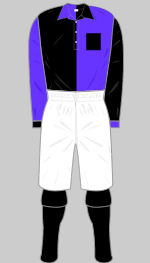
1882-1885 x
Woodville
Formed 1882

1884-1885 x
New Barnet
1885-1888
Formed by a merger of Woodville FC and Lyonsdown FC
1885-1888 a
Barnet
1888-1901
Fomerly New Barnet, the club was wound up in 1901.
1888-1889 a

1895-1898 1 a
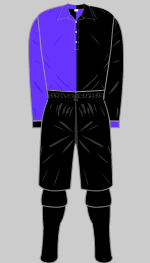
1896-1898 2
Alston Works Athletic
1901-1904

1903-1904 a
Barnet Alston
1904-1912
Fomerly Alston Works Athletic

1906-1907 a

1907-1912 a
Barnet
1909-1912
Formerly Barnet Avenue, formed in 1890 as Avenue FC. This is the second club to carry the name of Barnet.

1910-1911 a

1911-1912 a
Barnet & Alston
1912-1915
Formed by the merger of Barnet Alston and Barnet.

1912-1913 a

1913-1915 a
Barnet
1919
When Barnet Alston was reformed after the First World War, they changed their name to Barnet.

1919-1923 a

1923-1924 a
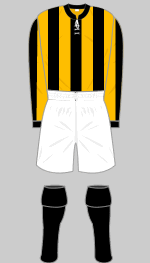
1924-1925 w

1928-1929 a

1931-1936 p

1938-1939 a b l n
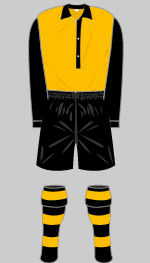
1945-1946 o
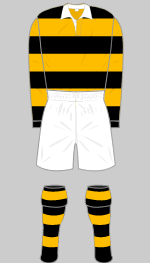
1946-1952 o q

1952-1955

1955-1956 u
1956-1957
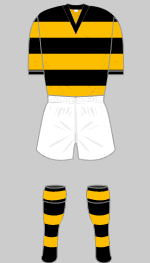
1957-1958 l q
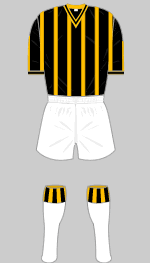
1958-1959 a

1962-1963 a
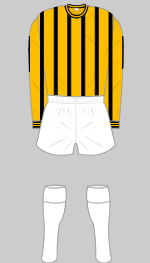
1963-1964 l q

1964-1966 a l q

1968-1971 a b l

1971-1972 f y

1972-1975 y

1976 c

1977-1978 a d t

1978-1979 f

1979-1980 a j

1980-1981 j
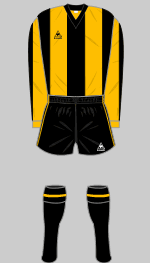
1981-1982 o

1982-1983 c

1983-1985 a o

1986-1988 a c k

1988-1989 c k v

1989-1991 c i k

1991-1992 d i
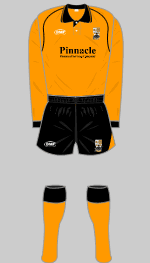
1992-1993 d i

1993-1994 d

1994-1995 (1) d i
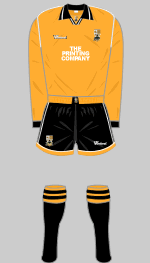
1994-1995 (2) d l

1995-1996 d i k

1996-1997 h

1997-1998 d

1998-1999 d k

1999-2000 d

2000-2001 d

2001-2002 c

2002-2003 c

2003-2004 d

2004-2005 b

2005-2006 b
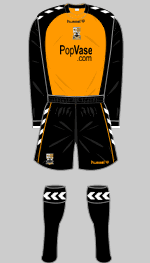
2006-2007 h
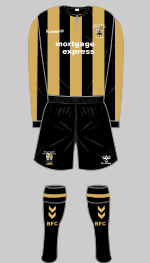
2007-2008 b
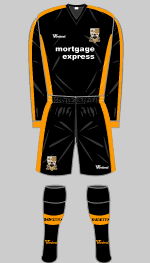
2008-2009 b
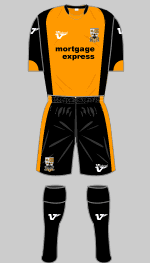
2009-2010 b
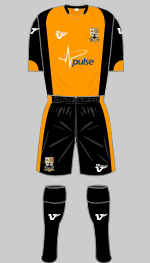
2010-2011 b
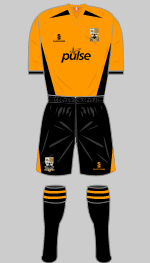
2011-2012 b
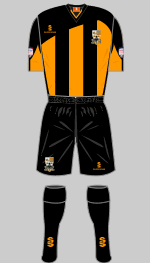
2012-2013 b
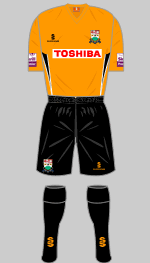
2013-2014 b

2014-2015 b
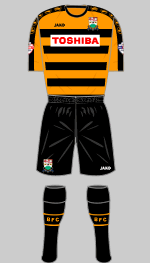
2015-2016 b
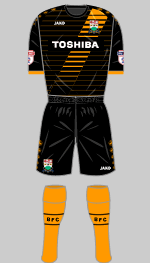
2016-2017 b
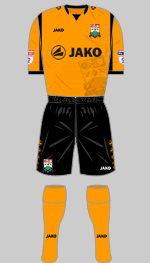
2017-2018 b
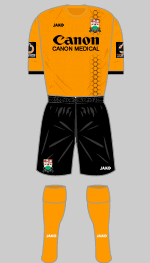
2018-2019 b
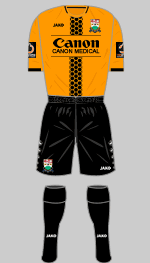
2019-2021 b
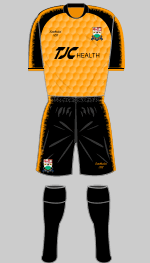
2021-2022 b
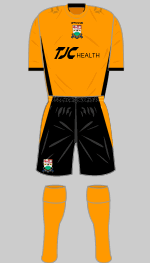
2022-2023 b
Background
 The early history of Barnet is both complex and confusing
and recent research has cast doubt on the official version. Records show
that in 1882 former pupils of Cowley College formed Woodville FC. At the
beginning of the 1885-86 season they merged with Lyonsdown FC and became
New Barnet FC. Players who failed to turn out in the official colours
of black shirts, stockings and caps with white knickerbockers faced a fine
of 6d (2.5p). After moving to a new ground in 1888, the club adopted the
title of Barnet FC. Playing in black and violet, the team competed in
the amateur Olympian League and later the North London League. In 1901
the club was suspended for six weeks for breaching the strict rules on
payments to amateur players. This precipitated a financial crisis and
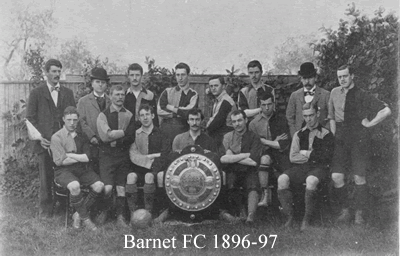
in November 1901, the original Barnet FC was wound up. Being (at least officially) an amateur team, players provided their own shirts and variations were commonplace. In the team photograph shown here no fewer than four different versions of their halved shirts are present.
The early history of Barnet is both complex and confusing
and recent research has cast doubt on the official version. Records show
that in 1882 former pupils of Cowley College formed Woodville FC. At the
beginning of the 1885-86 season they merged with Lyonsdown FC and became
New Barnet FC. Players who failed to turn out in the official colours
of black shirts, stockings and caps with white knickerbockers faced a fine
of 6d (2.5p). After moving to a new ground in 1888, the club adopted the
title of Barnet FC. Playing in black and violet, the team competed in
the amateur Olympian League and later the North London League. In 1901
the club was suspended for six weeks for breaching the strict rules on
payments to amateur players. This precipitated a financial crisis and
in November 1901, the original Barnet FC was wound up. Being (at least officially) an amateur team, players provided their own shirts and variations were commonplace. In the team photograph shown here no fewer than four different versions of their halved shirts are present.
Research by local historians Tony Rainer and Steve Wilmott suggests that the modern club is in fact descended from two quite separate sides who existed alongside, and indeed played against the original Barnet. The first of these was formed in 1890 by former pupils of Christ Church School and was known as Avenue FC and then Barnet Avenue FC. They competed in the North Middlesex League alongside Barnet FC. In 1903 two years after the original Barnet went out of existence, the Avenue club became themselves known as Barnet. In 1905 they joined the London League Second Division. Meanwhile, in 1901 the general manager of the Dental Manufacturing Company Ltd formed a football and athletic club for his staff, Alston Works Athletic FC. In July 1904 they became a senior side and changed their name to Barnet Alston. Playing in old gold and black, they were elected to the London League in 1906. In 1912 the two clubs merged to form Barnet & Alston FC and became founder members of the Athenian League. For a single season they played in the violet and black of the original club before adopting the black and amber colours of the former Alston team. When the club was reformed at the end of the First World War, they became simply Barnet FC and it may be argued that the modern club has its origin here.
The Bees (so called because of their amber and black strip) continued to play in the amateur Athenian League until they finally adopted professionalism in 1965 and joined the Southern League. Altogether they won the Athenian League championship seven times and the FA Amateur Cup once, in 1946.
 The club's crest was designed in the 1950s and contains the green hill of High Barnet. The red and white roses with crossed swords represent the 1471 Battle of Barnet, a pivotal incident in the Wars of the Roses. The badge was designed by Sidney Robert Price who was the chairman of the club at the time. It appeared on players' shirts for the first time in 1953 but did not become a regular fixture until 1986.
The late 1970s saw two of the games most colourful characters associated
with Barnet. 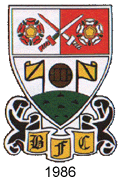 Jimmy Greaves ended his playing career with two seasons at
the club and Barry Fry became manager in 1978. In 1984, with the club
on the brink of closure, Fry moved to Maidstone United and a new chairman,
Stan Flashman bailed the club out. Two years later, Fry was back. When
it was announced that the Gola League in which Barnet competed would become
the Conference with a place in the Football League as its prize, Fry and
Flashman set out their ambition to take the club into the top flight.
Jimmy Greaves ended his playing career with two seasons at
the club and Barry Fry became manager in 1978. In 1984, with the club
on the brink of closure, Fry moved to Maidstone United and a new chairman,
Stan Flashman bailed the club out. Two years later, Fry was back. When
it was announced that the Gola League in which Barnet competed would become
the Conference with a place in the Football League as its prize, Fry and
Flashman set out their ambition to take the club into the top flight.
After a string of disappointing near misses, Barnet achieved promotion to Division Four in 1991 and capped this with promotion to the (new) Division Two in 1993. The new level proved too much and the following season Barnet were back in Division Three where they stayed until 2001 when they were relegated back to the Conference.
In 2002, the club sold the freehold on their ground to Barnet Borough Council in order to raise funds and in the expectation that the council would improve the facilities but none were forthcoming.
In 2005 the club won the Conference championship and returned to League football.
To mark 100 years at Underhill in 2007, Barnet unveiled an old gold and black kit, based on that of Barnet Alston. That August the chairman, Tony Kleanthous announced that he had acquired a site in Harrow that would be developed to provide artificial training pitches that could be rented out, generating much needed revenue, and a new stadium. Work started in the Autumn of 2008.
For the opening matches of the 2010-11 season, the team wore unsponsored shirts from the previous season until a sponsorship draw was belatedly organised. In October 2012, Barnet signed the former Dutch international, Edgar Davids, as player and joint head coach. In December, Davids found himself in sole charge. Three months later Barnet played their last game at Underhill and moved into the newly completed Hive Stadium in Harrow. The move was followed by huge disappointment when, on 27 April, Barnet were relegated to the Conference on goal difference.
Three years later Barnet were back in the Football League after winning the Conference championship and to celebrate they revived their hooped shirts, first seen in 1928. Unfortunately they managed only three seasons before dropping back into non-league football.
In 2021 Dover Athletic and Macclesfield Town had their results expunged, leaving Barnet bottom of the National League but they were reprieved from relegation to preserve numbers in the fifth tier after fixtures in the Conference North and South were abandoned.
Sources
- (a) History of Barnet FC Website. No longer available.
- (b) Official Barnet FC site
- (c) Alliance to Conference (John Harman 2005)
- (d) empics
- (e) kitclassics
- (f) Supporters Association website
- (g) Club Colours (Bob Bickerton 1998)
- (h) James Fenn
- (i) David King
- (j) Alick Milne
- (k) Michael Hanley
- (l) Keith Ellis (HFK Research Associate)
- (m) Jake Lord
- (n) Simon Monks
- (o) Michael Gluck
- (p) Steve Wilmott
- (q) ebay
- (r) The Straw Plaiters
- (s) Alliance to Conference 1979-2004 submitted by Michael Gluck
- (t) James Fenn
- (u) Gary Drew
- (v) Lee Capeling
- (w) Tony Sealey
- (x) Charles Alcock's Football Annuals 1868-1891 researched by Robin Horton
- (y) Richard Ralph
Crests are the property of Barnet FC. Photograph courtesy of The Straw Plaiters.